
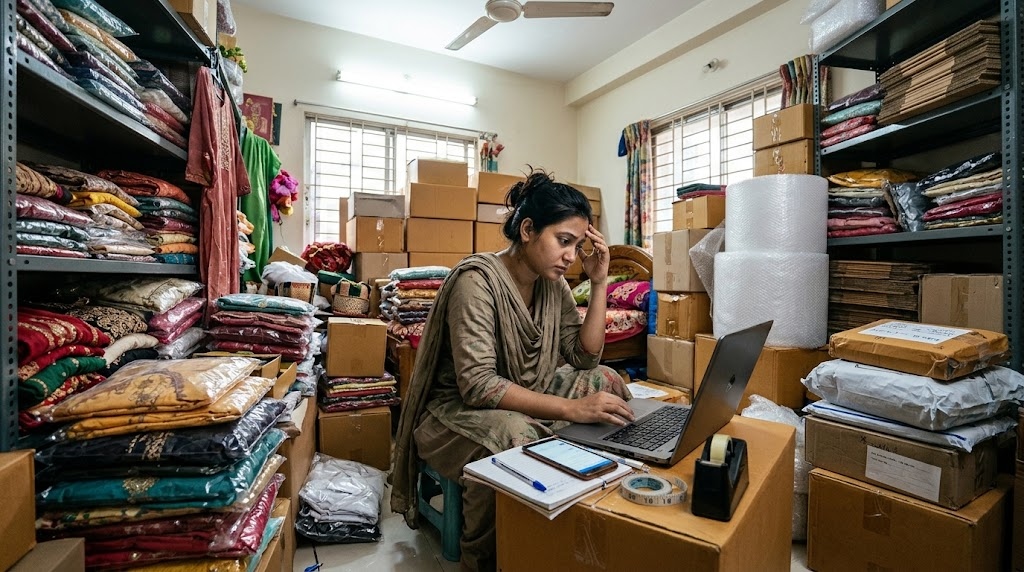
Top Challenges of F-Commerce Based SMEs in Bangladesh
Top Challenges of F-Commerce Based SMEs in Bangladesh
Quick answer: F-commerce SMEs in Bangladesh run the whole business inside one Facebook Page — inquiry, negotiation, order, payment confirmation, delivery follow-up and complaint all happen in the same inbox. The ten challenges that cap growth are: unowned inbox volume, manual order capture, COD confirmation, unattributable marketing, public complaint handling, a market-wide trust deficit, single-person dependency, stock and price drift, platform risk, and no operating data. The root cause is the same in all ten: the conversation is your storefront, but nothing behind the conversation is a system.
Key Takeaways
- The channel is not the problem — the missing layer behind it is. Facebook works as a storefront; what fails is intake, capture, and follow-through.
- Bangladesh is a Facebook market before it is an e-commerce market: 64.0 million Facebook users (Meta ad data, late 2025) against a few thousand e-CAB member firms and an estimated 500,000+ business Pages.
- Ten challenges, one root cause: conversation data that never becomes a structured record — no order, no ticket, no owner, no timestamp.
- Hiring is the wrong lever. Reply volume grows faster than headcount, and every new hire multiplies password-sharing and lost context, not throughput.
- The fix is architectural, in two moves: an AI-powered omnichannel communication layer in front of the Page, and an ERP (single source of truth) behind it.
- Fix intake first, ERP second. An ERP cannot fix an inbox nobody owns; an inbox without an ERP still cannot tell you your true cost per delivered order.
- What to measure before you buy anything: first-response time, unanswered-thread count, order-to-inbox reconciliation rate, and cancellation reason mix.
Why is F-commerce still the default business model in Bangladesh?
Because the barrier to entry is zero and the audience is already there. A trader in Islampur or a boutique in Banani can open a Page, post a product, and take an order in the same hour — no company registration, no payment gateway, no website, no developer.
The scale is not marginal. Meta's advertising data put Facebook at 64.0 million users in Bangladesh in late 2025, and the E-Commerce Association of Bangladesh (e-CAB) estimates more than 5 lakh (500,000) Bangladeshi business Pages on the platform, with industry estimates ranging up to one million entrepreneur-focused Pages. Against that, e-CAB's own paid membership is around 3,000 firms — the formal layer is a rounding error next to the informal one.
That gap is the entire story of this article. F-commerce in Bangladesh is not a starter version of e-commerce that will mature into Shopify. It is a conversation-native commerce model, and it will stay that way — which means the businesses that win are the ones that industrialise the conversation, not the ones that abandon it.
What are the top 10 challenges of F-commerce based SMEs in Bangladesh?
At a glance, with the operating cost each one imposes:
| # | Challenge | What it actually costs you |
|---|---|---|
| 1 | The inbox is the storefront — and nobody owns it | Lost inquiries, slow replies, invisible backlog |
| 2 | Every order has to be re-typed by hand | Wrong SKU, wrong address, orders that never get recorded |
| 3 | COD confirmation is a manual call centre | Cancellations, return freight, cash tied up in failed deliveries |
| 4 | Marketing spend cannot be traced to a sale | Budget judged on reach, not on revenue |
| 5 | Complaints happen in public, with no SLA | Reputation damage, refunds, regulatory exposure |
| 6 | Trust is the scarcest asset in the market | Lower conversion, advance-payment resistance, higher scrutiny |
| 7 | One person holds the Page — and the business | Turnover wipes out history; growth capped at one person's hours |
| 8 | Stock and price truth lives in WhatsApp and Excel | Overselling, stale posts, apology discounts |
| 9 | Platform risk and channel sprawl | A restricted Page halts revenue; WhatsApp/IG/TikTok add inboxes |
| 10 | No operating data, so no decisions | Can't price, can't forecast, can't tell what to fix |
Each challenge below names the symptom, the real cost, and what "fixed" looks like — so you can score yourself honestly before reading the fix section.
1. The inbox is the storefront — and nobody owns it
A single Facebook Page generates three different streams that feel like one: public comments ("দাম কত?"), Messenger DMs, and Inbox messages that arrive when the Page is inactive. Add Instagram DMs, a WhatsApp number on the post image, and a phone number in the About section, and a two-person team is now monitoring five surfaces with zero shared view.
The practical failure is not "slow replies" — it is unowned replies. When two staff both see a message, nobody answers. When both are on a delivery run, the thread sits for six hours and the buyer has already ordered from a competitor whose reply landed in four minutes. Meta's own Page metrics reward fast responders with a response-rate badge, which becomes a conversion asset the slow page cannot buy back.
- Real cost: the majority of F-commerce losses are not rejections — they are silences. An inquiry that gets no reply never appears in any report, because no report exists.
- Fixed looks like: one shared inbox, every channel, every conversation assigned to a named owner with a first-response clock.
2. Every order has to be re-typed by hand
There is no "add to cart" in a comment thread. The customer writes "এই জিনিস টা ৫০০ টাকা, ২ পিস দিবেন, মিরপুর ১০" — and a human has to convert that into a structured order: item, variant, quantity, price, delivery zone, phone, address, advance paid.
That manual transcription step is where F-commerce leaks money quietly:
| What goes wrong | Downstream damage |
|---|---|
| Variant confusion (colour/size) in a screenshot thread | Wrong item shipped, return + return freight |
| Address captured as a landmark, not an address | Courier failed-delivery charge, redelivery cost |
| Order agreed in comments, never entered anywhere | Order simply not shipped; customer escalates publicly |
| Same customer orders via DM and WhatsApp | Duplicate shipment, double courier cost |
An order that exists only in a chat thread is not an order — it is an intention with a timestamp. Everything after it (stock, courier, cash, reconciliation) is guesswork.
- Fixed looks like: the conversation itself produces a structured order record — items, quantity, price, address, phone — that flows into one place you can filter, count and reconcile.
3. Cash-on-delivery confirmation is a manual call centre
Cash-on-delivery remains the default payment method for Bangladeshi online commerce, and F-commerce adds its own layer: bKash/Nagad advance on trust for anything bespoke or high-value. That means every order needs a confirmation step — a call or message to verify the address, the item, and the willingness to pay.
Most pages do this from a personal phone, from memory, with no script and no record. The result is a cancellation rate nobody can explain and a return-freight bill nobody forecasts.
- Real cost: double courier charges on failed deliveries, cash locked in returned stock, and a per-parcel loss that quietly eats the margin on low-ticket items.
- Fixed looks like: automated confirmation sequences with structured replies (Confirm / Change address / Cancel), cancellation reasons captured as data, and a confirmation rate tracked per campaign — not per person's memory.
4. Marketing spend cannot be traced to a sale
A Page can boost a post and see reach, clicks, and cost per click. It cannot tell you how many of those clicks became delivered, paid orders — because the sale closed in a DM that the ad platform never sees.
So the business runs on the only numbers available: reach, engagement, and "sales felt good this week." Budget gets reallocated on vibes. Winners get killed because they generated DMs instead of clicks, and losers survive because they generated likes.
| What you can see today | What you actually need |
|---|---|
| Reach, engagement, cost per click | Cost per confirmed order |
| Comments count | Cost per delivered order |
| Follower growth | Repeat-purchase rate by cohort |
| "Sales felt good" | Revenue per 1,000 conversations |
- Fixed looks like: every conversation carries its source (post, boost, comment, referral), and the order record inherits it. Then the boosted post and the delivered parcel sit in the same row of a report.
5. Complaints happen in public, with no SLA
A delayed parcel is a private problem until the buyer comments on your pinned post. Then it becomes a public one, and the reply speed of the next answer determines whether onlookers read "responsive seller" or "scam page."
The regulatory backdrop is real. The Directorate of National Consumer Rights Protection (DNCRP) received complaints against 4,982 Facebook Pages between July 2017 and August 2021 — and that was before the market's most recent growth phase. Complaints cluster around the same few causes: no delivery, wrong item, no refund, no reply.
Most SMEs handle this with screenshots saved to a phone gallery and an escalation path that runs through a personal WhatsApp group. There is no SLA, no severity level, no owner, and no memory of how the last identical complaint was resolved.
- Fixed looks like: a complaint becomes a ticket the moment it is detected — severity, owner, deadline, resolution note — with a template reply for the public thread and a private thread for the details.
6. Trust is the scarcest asset in the market
Bangladesh's F-commerce market carries a trust discount created by others. The Cyber Crime Awareness Foundation found that 11.48% of online shoppers reported being deceived in 2020, up from 7.44% in 2019 — and the deep-discount collapses of 2021 have kept "advance payment" a red flag in buyers' minds ever since.
For an honest SME, that history is a tax. Every new customer arrives carrying three questions: Is this page real? Will I get the product? Will I get my money back if I don't?
- Real cost: lower conversion on identical products, resistance to advance payment (which pushes you toward COD and its cancellation risk), and a longer persuasion cycle per order.
- Fixed looks like: visible, consistent, fast professionalism — answered in minutes, order confirmed in writing, tracking shared proactively, refund policy stated in the thread. Trust is an operational output, not a slogan.
7. One person holds the Page — and the business
In most F-commerce SMEs, one person holds the Facebook login, the courier relationship, the price list, the customer history, and the judgement calls. When they take a day off, the business takes a day off. When they leave, the business loses its memory.
Adding staff does not fix this — it exposes it. Two people logged into one profile means two people replying to the same customer, two people editing the same order, and no way to tell who promised what. Sharing a password is also how Pages get locked in a Business Manager review at the worst possible moment.
- Fixed looks like: role-based access instead of shared credentials, conversation ownership, and a searchable history that belongs to the business rather than to whoever is holding the phone.
8. Stock and price truth lives in WhatsApp and Excel
The post says ৳1,250. The pinned comment says ৳1,150. The receptionist's notebook says "শেষ". The warehouse says "৩ পিস আছে". All four are true at different moments, and the customer gets the one that costs you the sale.
Overselling is the expensive version of the same problem: three orders accepted for two units, two apologies, one public complaint.
- Fixed looks like: one price and one stock position, with the reply generated from it. When stock changes, the answer changes — not the other way around.
9. Platform risk and channel sprawl
A single restricted Page, a hacked profile, or an account review can switch off 100% of revenue overnight — and it has happened at national scale in Bangladesh, where internet restrictions have repeatedly interrupted F-commerce operations.
At the same time, channel sprawl is increasing: WhatsApp Business, Instagram, TikTok Shop-style flows, and a phone number that still rings. Every new channel multiplies inboxes and fragments customer history further.
- Fixed looks like: a channel-agnostic intake layer — one place where Facebook, WhatsApp, Instagram and web enquiries land as the same kind of object — plus a customer list you own and can reach off-platform.
10. No operating data, so no decisions
Ask a typical F-commerce owner four questions and watch what happens:
| Question | Typical answer |
|---|---|
| What is your first-response time? | "Fast, usually." |
| How many inquiries did you miss last month? | "Not many." |
| What is your cancellation rate, and why? | "Courier's fault, mostly." |
| What is your repeat-purchase rate? | Silence |
Without answers, pricing is a guess, hiring is a guess, and scale is a hope. This is the challenge that makes the other nine permanent — you cannot fix what you cannot see.
Why does hiring more people not fix the inbox problem?
Because the bottleneck is not typing speed — it is coordination and context. Two people sharing one inbox without ownership rules create duplicate replies, contradictory promises, and dropped threads. Five people create five times the confusion.
| Lever | Effect on throughput | Effect on cost | Effect on quality |
|---|---|---|---|
| Add headcount | Linear, at best | Linear and permanent | Degrades (context splits) |
| Add shifts | Linear | Linear | Flat |
| Add a shared inbox with ownership | Step change | Flat | Improves (nothing dropped) |
| Add AI triage + assisted replies | Step change, compounds | Marginal per conversation | Improves (consistent answers) |
The arithmetic that matters: your message volume is not flat — it spikes on campaign days and before Eid. Headcount sized for the peak is idle at the trough; headcount sized for the average drowns at the peak. The only structures that survive both are assignment rules and automated first response.
What does an AI-powered omnichannel communication platform change?
It changes the unit of work. Instead of a human reading a message and deciding what it is, every inbound message becomes an object with a type (inquiry, order, complaint, follow-up), a customer, a channel, an owner, and a clock. Once that is true, the ten challenges stop being people problems and become configuration problems.
| Challenge | What the platform does |
|---|---|
| 1. Unowned inbox | One shared inbox across Facebook, WhatsApp, Instagram, web; round-robin assignment; first-response SLA timer per thread |
| 2. Manual order capture | AI extracts item, variant, quantity, phone, address from free-text Bangla/Banglish and writes a structured order |
| 3. COD confirmation | Automated confirmation sequences with structured replies; cancellation reasons captured as data |
| 4. Untraceable marketing | Source tagging from post/boost/comment → conversation → order → delivered, one report |
| 5. Public complaints | Complaint detection and intent classification, severity + owner + deadline, public/private reply templates |
| 6. Trust deficit | Sub-minute first response, written confirmation, proactive tracking updates, consistent policy answers |
| 7. Single-person dependency | Role-based access, no shared passwords, full searchable history owned by the business |
| 8. Stock/price drift | Answers generated from one catalogue and one stock position; changes propagate instantly |
| 9. Channel sprawl | Channel-agnostic intake; a first-party customer list you can reach off-platform |
| 10. No data | Response time, backlog, cancellation mix, top intents, repeat rate — measured continuously, not remembered |
Two caveats that separate a working deployment from a demo:
- Bangla and Banglish are the test. A platform that only handles clean English will fail on "দাম কত?", "ei ta ache?", and "delivery charge koto". Test with your own last 200 real messages before you sign anything.
- AI should draft, humans should approve, at first. Start with AI drafting replies and extracting order details while a human sends. Move to autonomous replies only for the narrow intents you have measured — price, stock, delivery time, order status. Everything about money and complaints should escalate.
Where does the ERP fit behind all of this?
An omnichannel layer fixes the front door. It does not fix the fact that the order, the stock, the invoice and the courier are still four separate truths.
The end state is one loop: a conversation produces an order; the order draws from real inventory; delivery confirmation from the courier closes the order; revenue and returns land in the ledger — and the same record answers the customer's next message ("আমার অর্ডার কোথায়?"). That is the single-source-of-truth principle Metamorphosis builds on: not a chatbot bolted onto a Page, but one intelligence layer that spans intake, operations and finance — the same principle behind Odoo's AI-first direction, from Ask AI in Odoo 20 to autonomous operations, grounded in your own data rather than generic model knowledge (RAG architecture).
Practical sequencing for a Bangladeshi SME:
| Phase | What you do | Why in this order |
|---|---|---|
| 0 (week 1) | Baseline: response time, unanswered count, order reconciliation, cancellation reasons | You cannot prove ROI on a number you never recorded |
| 1 (weeks 2–6) | Shared omnichannel inbox + AI-drafted replies for price/stock/delivery | Fastest measurable win: response time and backlog |
| 2 (weeks 6–12) | Structured order capture + COD confirmation + source tagging | Turns conversations into countable orders |
| 3 (month 4+) | ERP behind it: inventory, courier integration (shipping customization), invoicing, local compliance (Bangladesh localization) | One record from inquiry to cash |
Cost the whole thing before you start — the same discipline as any ERP business case, which is what our ROI framework is for.
Checklist — score your F-commerce operation this week
- Count the backlog. Open the Page inbox and count threads older than 24 hours with no reply. Write the number down.
- Time ten replies. Pick ten random inquiries from last week and measure first-response time.
- Reconcile one day. Take yesterday's confirmed orders and compare them against messages actually received. The gap is your invisible loss.
- Extract your cancellation reasons. Pull 30 cancelled orders and tag each reason. If you cannot tag them, that is the finding.
- List your channels and owners. Facebook, WhatsApp, Instagram, phone — who owns each, between which hours?
- Test Bangla. Paste 20 real customer messages into any AI tool you are evaluating. Count how many it understands correctly.
- Name your single point of failure. If one person is unavailable for a week, what stops?
- Check price and stock consistency. Compare your last three posts, the pinned comment, and what your team quotes today.
The conversation is not a marketing channel — it is your order entry system, your helpdesk, and your only source of customer truth. That is why the ten challenges above are not ten separate problems to be solved with ten separate tools and three more hires. They are one architectural gap: a business running on conversations with no layer that turns conversations into records.
Fix that layer and the same team, on the same platform, with the same audience, can carry several times the volume — because they are no longer acting as the database.
Metamorphosis Ltd. is the pioneer certified Odoo Silver Partner in Bangladesh, engineering AI-first, autonomous operating systems for manufacturers, FMCG and retail businesses — from Grameen Danone to Idiya Limited and Shanta Lifestyle. We build the AI-powered omnichannel communication layer in front of your sales channels and the ERP single source of truth behind them, so no inquiry waits, no order is re-typed, and no complaint is answered from memory. Assess your AI readiness or talk to our consultants about an F-commerce intake audit.
— Sadiq M Alam, Odoo Functional Consultant & COO, Metamorphosis Ltd.
FAQs
-
What are the biggest challenges of F-commerce in Bangladesh? The ten that cap growth are: an unowned multi-channel inbox, manual order capture, COD confirmation done by phone and memory, marketing spend that cannot be traced to a delivered order, public complaints with no SLA, a market-wide trust deficit, dependency on one person holding the Page, stock and price drift between posts and warehouse, platform risk plus channel sprawl, and the absence of operating data. All ten share one root cause: conversations never become structured records.
-
How do F-commerce businesses in Bangladesh take orders from Facebook? Almost entirely through conversation. A customer comments or messages with a product question — usually in Bangla or Banglish, such as "দাম কত?" — negotiates in the thread, and the seller manually copies the item, quantity, phone number and address into a notebook, a spreadsheet or a courier panel. Because there is no cart or checkout, the order exists only as long as someone remembers to transcribe it.
-
Why do F-commerce pages lose customers in the inbox? Not usually through rejection but through silence. Comments, Messenger DMs and Inbox messages arrive on separate surfaces with no ownership, so a message seen by two staff can be answered by neither. Buyers comparing two pages typically order from whichever replies first, and slow response also costs the Page its response-rate badge, which affects conversion on future visitors.
-
How can a small business in Bangladesh reply to customer messages faster? Three moves, in order: put every channel into one shared inbox with named ownership and a first-response timer; automate the first reply for the four highest-volume intents (price, stock, delivery time, order status); and capture order details as structured data instead of re-typing them. Most response-time gains come from ownership and templates, not from hiring.
-
What is an AI-powered omnichannel communication platform? It is a layer that collects messages from Facebook, Instagram, WhatsApp, web chat and phone into one queue, uses AI to classify each message's intent, draft or send replies, extract order details, detect complaints, and route anything sensitive to a human — while keeping every conversation attached to one customer record. It differs from a chatbot because it operates across channels and produces structured records, not just replies.
-
Can AI handle Facebook Messenger orders and complaints for a small business? Partly, and the boundary matters. AI is reliable today for high-volume, low-risk intents: price and stock questions, delivery timelines, order status, and drafting a complaint acknowledgement. Money movements, refunds, custom quotes and escalated complaints should stay with a human. The safe pattern is AI drafts, human sends, then autonomy for the intents you have explicitly measured and approved.
-
Why does hiring more staff not fix F-commerce customer service? Because the bottleneck is coordination and context, not typing speed. Multiple people sharing one Page log in without ownership rules duplicate replies, make conflicting promises, and still drop threads. Headcount also scales linearly in cost while volume spikes on campaign days and before Eid, so any team is either idle at the trough or drowning at the peak. Shared inbox ownership plus automated first response changes throughput without proportional cost.
-
What should an F-commerce SME measure before buying a communication platform? Four baselines: first-response time, the count of threads unanswered beyond 24 hours, the reconciliation gap between confirmed orders and messages received, and the reason mix on cancelled orders. Without these you cannot prove the platform worked, and vendors will report activity metrics instead of outcomes. Also test any AI on 200 of your own real Bangla and Banglish messages before signing.
-
Does fixing the inbox remove the need for an ERP? No — they solve different halves. The communication layer fixes intake: nothing is missed, nothing is re-typed, nothing is answered from memory. The ERP fixes truth: one inventory position, one order record, one ledger, and courier and invoice data attached to the same order. An ERP cannot fix an inbox nobody owns, and an inbox without an ERP still cannot tell you your real cost per delivered order.
Sources: DataReportal, Digital 2026: Bangladesh (Meta advertising data, Facebook 64.0 million users in Bangladesh, late 2025) · The Business Standard, "Facebook restriction keeps F-commerce entrepreneurs at bay" (e-CAB estimate of 5 lakh+ Bangladeshi business Pages); BSS report on industry estimates of 500,000–1 million entrepreneur-focused Facebook Pages and e-CAB membership of ~3,000 · The Daily Star, "Complaints against Facebook shops on the rise" (DNCRP: complaints against 4,982 Facebook Pages, July 2017–August 2021) · Cyber Crime Awareness Foundation annual research, via Dhaka Tribune (11.48% of online shoppers deceived in 2020, up from 7.44% in 2019) · US International Trade Administration country guide and PCMI for cash-on-delivery as Bangladesh's dominant e-commerce payment method. Market estimates vary by source and methodology — treat them as directional, not audited.
Vond je dit inzicht leuk?
Deel uw mening of neem contact op om te bespreken hoe deze strategieën op uw bedrijf van toepassing zijn.
Neem contact op