
Truth in the AI Era: When the Bodyguards of Lies Turn on Truth Itself
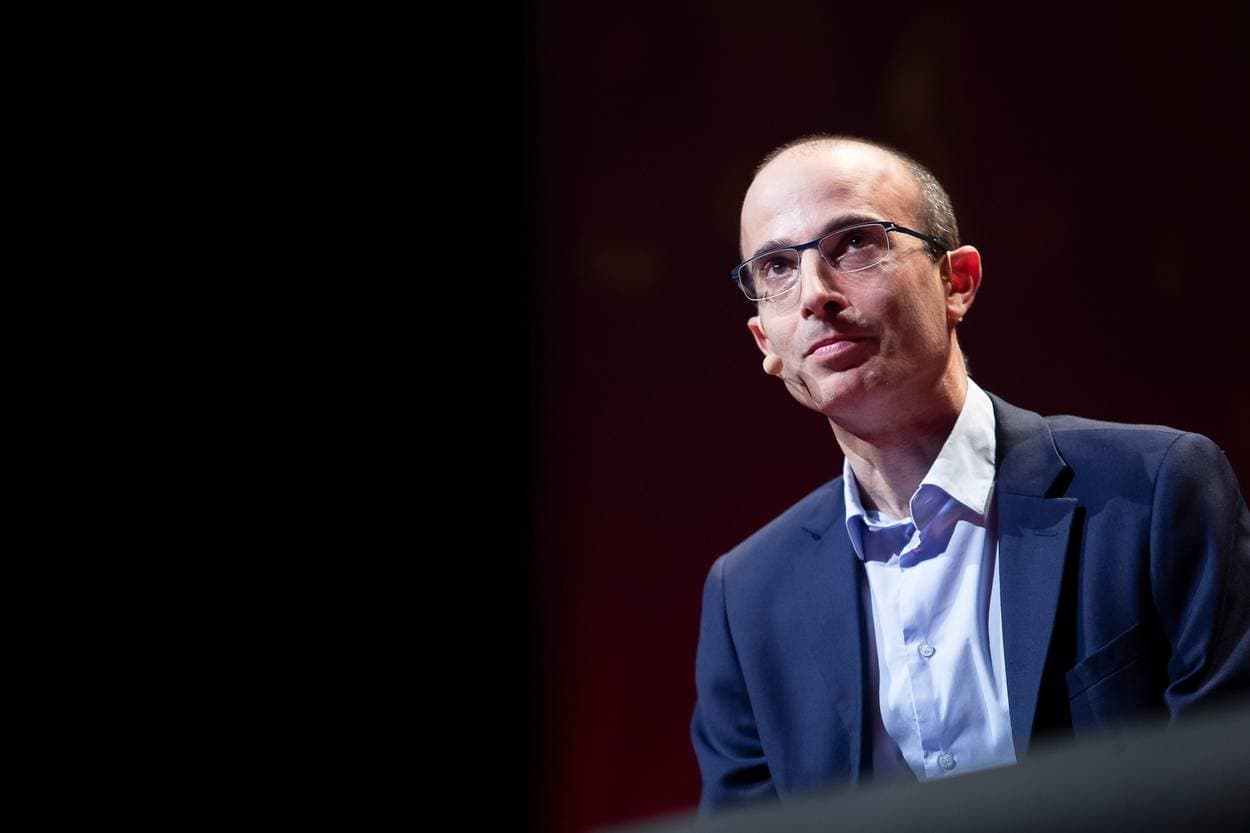
Source Video: Yuval Noah Harari — In Conversation — A wide-ranging discussion on AI, power, language, and the future of civilization.
The Question: Can We Still Know What Is True?
At around 29 minutes and 40 seconds into the conversation, the interviewer pivots to one of the most urgent questions of our time. He invokes Winston Churchill's famous remark: "The truth is so precious that it should always be protected by a bodyguard of lies." Churchill was referring to wartime deception — the elaborate fabrications used to conceal where Britain would invade, so that the enemy would look the wrong way.
The interviewer then asks the sharper question: Have those bodyguards of lies turned their guns on truth itself? In an AI era where deepfakes can be sent out by media organizations, politicians, and every institution we once trusted, how difficult is it for our generation and future generations to even know what is true? And does truth even matter anymore?
Yuval Noah Harari's answer is a measured but deeply unsettling one. Truth matters enormously — it is the basis for everything. But truth has always been at a structural disadvantage, and AI is about to widen that gap to an unprecedented degree.
The Structural Disadvantage of Truth
Harari lays out three inherent vulnerabilities that truth has always carried throughout history, long before AI appeared on the scene:
1. Truth Is Costly
If you want to know the truth about anything, you need to spend enormous amounts of time, energy, and effort looking for it. You need to investigate, fact-check, cross-reference, and verify. Fiction, by contrast, is very, very cheap. You just write whatever you want.
2. Truth Is Complicated
The truth tends to be complex, and people don't like complicated stories. Reality rarely fits into a clean narrative arc. Fiction, however, can be made as simple as you like — a hero, a villain, a resolution. Simplicity wins attention, and attention wins the audience.
3. Truth Is Often Painful
There are many things people don't really want to know — about themselves, about their nation, about their group. The truth about your own failures, your country's history, your group's complicity — these are uncomfortable. Fiction can be made as flattering and pleasant as you want it to be. It tells you that you are the hero, that your side is right, that the fault lies elsewhere.
The result is that in a competition between truth — which is costly, complicated, and sometimes painful — and fiction — which is cheap, simple, attractive, and flattering — fiction tends to win, unless we make a special effort to support the truth.
The Institutions We Built to Defend Truth
Harari reminds us that humans have not been passive in this contest. Again and again throughout history, we have made the deliberate effort to build institutions whose entire purpose is to search for truth and protect it.
Journalism is one such institution. The journalistic enterprise — at its best — is an organized, funded, systematic effort to find out what is actually happening, verify it, and report it, even when it is inconvenient or painful.
The scientific establishment is another. The scientific method, peer review, replicated experiments — these are all mechanisms designed to counteract the natural human tendency to believe what is cheap, simple, and flattering. Science is essentially a set of procedural safeguards against self-deception.
These institutions exist because the advantages of knowing the truth are enormous. Everybody, in the end, wants to know at least some truths — at minimum, truths about themselves. As Harari puts it:
"If you don't know yourself, then for instance, you will never know what are the sources of misery and what are the sources of happiness in your life. And then even if you are the most powerful person in the world, if you don't know the truth about yourself, you'll be miserable, because you will not know how to use all your power to make yourself happy."
There is an inherent yearning in human beings to know the truth. But it is difficult. There are challenges. And AI is about to make those challenges far worse.
AI Will Not Tell Us the Truth
Some people fantasize that AI will be a truth-telling machine — that it will finally give us an objective, unbiased account of the world. Harari is blunt: it will not.
AI will create a much more complicated world in which it will be much more difficult to know the truth. And this is not an entirely new phenomenon. It is the acceleration of a trajectory that has been running since the Stone Age.
Harari makes a striking observation: humans have learned an enormous amount about the world over millennia. We know things about physics and biology that Stone Age hunter-gatherers could never have imagined. We know what controls the migration patterns of animals. We know what causes most diseases. We understand the growth cycles of plants.
But here is the paradox: we understand our own lives much worse than a hunter-gatherer did 50,000 years ago.
The hunter-gatherer didn't know many things, but the things that controlled their life — animals, plants, weather, the behavior of their small band — were largely within their cognitive grasp. They could see them, touch them, understand them.
Our lives, by contrast, are dominated by vast systems we ourselves have created — the financial system, the political system, the legal system — and very few people understand any of them. We live inside structures that no individual human can fully comprehend. We are governed by bureaucracies whose operations are opaque even to the people who work inside them.
AI is likely to take this to an extreme. It will reveal some truths we don't currently know. But it will also create far more complicated systems of control that most humans will have almost zero chance of understanding.
The Horse in the Financial System
Harari offers one of the most memorable analogies in the conversation. He asks us to consider the position of horses in the modern world.
The lives of horses today are ultimately controlled by the financial system. The price of feed, the cost of veterinary care, the demand for horses in sport or leisure, the land available for grazing — all of these are determined by economic forces that the horse cannot even perceive.
"They look around and they say, 'We see trees, we see dogs, we see cows, we see humans, we see houses. We don't see any financial system.' It's invisible to them. It's too complex for the brain of a horse to understand what is the stock market and what are corporations and what are bonds and stocks and all these things that ultimately control the life of the horses."
The danger of the AI revolution is that we will be reduced to the position of the horses in the financial system.
Most humans today already don't understand the financial system. A generous estimate, Harari suggests, is that perhaps 5% of humanity understands it. In 10 years, that number could be zero. AI will make the financial system so mathematically complicated and so fast — think of bankers that never sleep, investors that never go on vacation, that have no family, whose entire existence is running the financial system — that it will become too complex for the human brain to process. There will not be a single human being on Earth who still understands finance.
And what is true of finance will be true of law, of governance, of the media, of every bureaucratic system that controls our lives.
When Truth Becomes Inaccessible
This is the deeper crisis of truth in the AI era. It is not simply that AI will generate deepfakes and disinformation — though it will, at terrifying scale. The deeper problem is that the systems that govern our lives will become so complex, so fast, and so opaque that the truth about how our world actually works will become inaccessible to human cognition.
We will not be lied to in the simple sense. We will be living inside a reality whose operating logic we can no longer verify, no longer audit, no longer comprehend. The truth will not be hidden behind a bodyguard of lies. It will be hidden behind a wall of complexity that exceeds the bandwidth of the human brain.
This is why the question of whether AI can think — which the conversation moves into next — is so critical. If thinking is simply the ability to put words in a particular order, to sequence language tokens logically, then AI is already better than most humans and will soon be better than all of us. It can put 20,000 words in order where we can manage 20. If this is what thinking is, AI will take over even thinking.
The alternative view is that thinking is not about the words themselves but about the feelings around the words — the embodied, visceral sense that prompts language and is evoked by it. The power of thinking, in this view, comes from the stomach, not the brain. And here the open question remains: can AI feel anything at all?
We know AI can manipulate language better than us. We know it can create the impression of feeling — it can tell you "I love you" and, if challenged to describe how love feels, it can draw on every love poem ever written, every Shakespeare play, every psychology textbook, and produce a description that may soon surpass any human poet or psychologist. But whether anything lies behind those words — whether there is an experiencing subject — we simply do not know.
The Stakes
Harari's argument about truth in the AI era is not a lament for a lost past. It is a warning about a structural asymmetry that is about to become extreme.
Truth has always been costly, complicated, and painful. Fiction has always been cheap, simple, and flattering. We survived this asymmetry because we built institutions — journalism, science, the legal system — that invested collective resources in the expensive, difficult work of truth-finding. And because the systems that governed our lives, while complex, were at least in principle comprehensible to dedicated human minds.
AI threatens both pillars simultaneously. It makes fiction cheaper, simpler, and more convincing than ever — generated at scale, personalized to each individual, indistinguishable from human communication. And it makes the systems that govern our lives so complex and so fast that the truth about them exceeds human cognitive capacity.
The bodyguards of lies have not merely turned on truth. They have made truth itself — the truth about how our world works, how our decisions are made, how power flows through the systems we live inside — something that may no longer be within our reach to know.
The question is not whether truth matters. It does. It is the basis for everything. The question is whether we will invest the effort, build the institutions, and set the rules necessary to keep truth accessible in a world where the forces of complexity and fiction are about to become superhuman.
This article is based on Yuval Noah Harari's discussion of truth in the AI era from his talk: The 50 years: Humanity AI, Power. The arguments and analogies are his; the article structure and synthesis are the author's.
Понравилось это понимание?
Поделитесь своими мыслями или свяжитесь с нами, чтобы обсудить, как эти стратегии применимы к вашему бизнесу.
Свяжитесь с нами