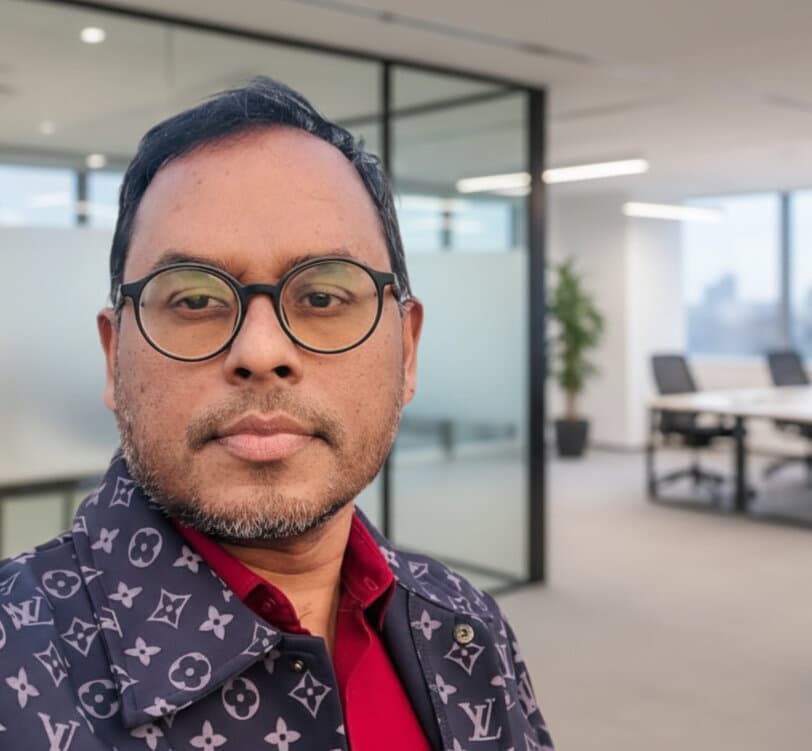
Participating at the Bangladesh AI Summit 2026
Participating at the Bangladesh AI Summit 2026
By Sadiq M Alam · Dhaka · 5 November 2026
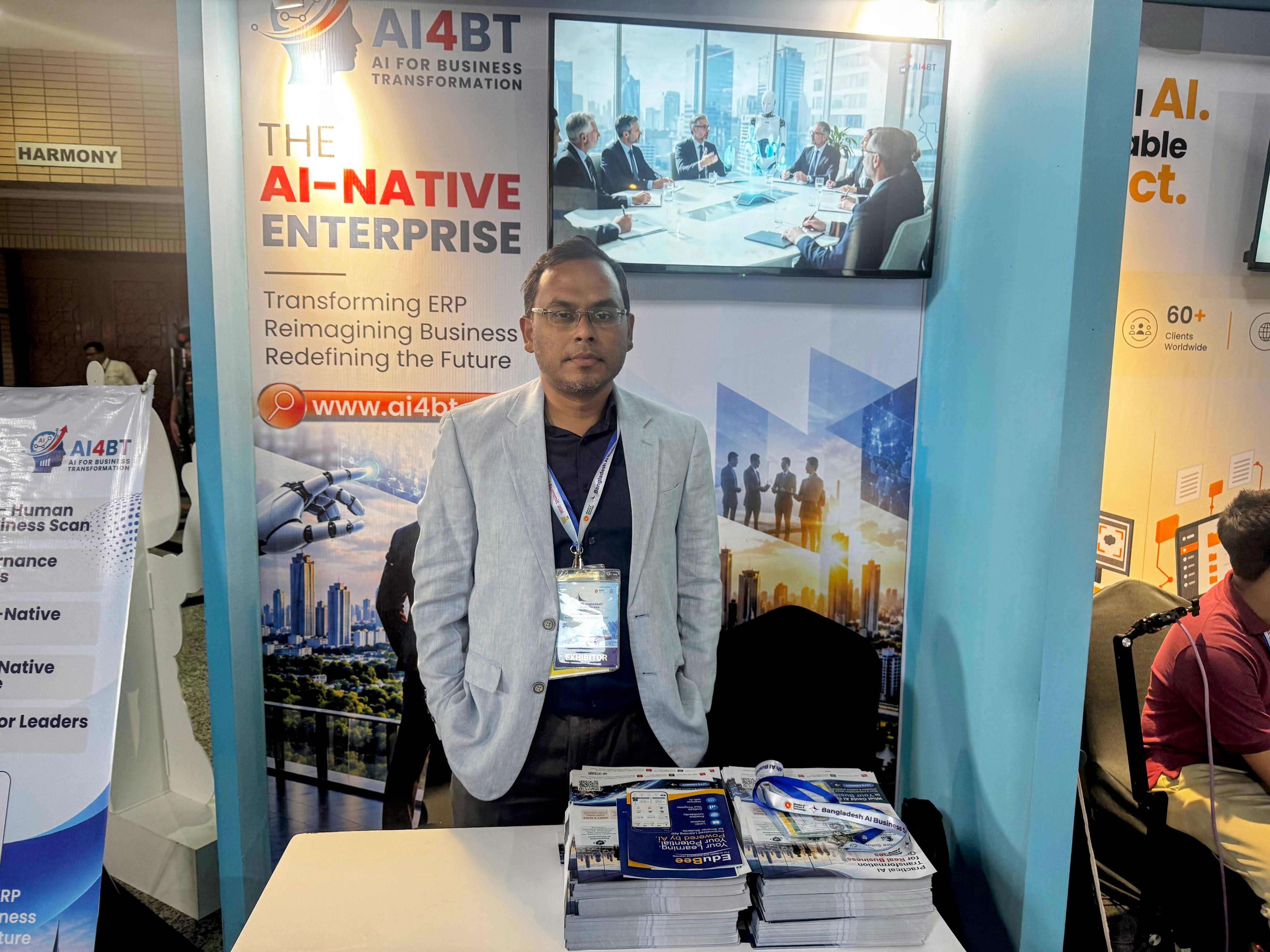
It is a little past ten in the morning, the floor of the Hall of Fame at the Bangladesh-China Friendship Conference Centre in Agargaon is already crowded, and I am standing at Booth 30 with a marker in one hand and a stack of readiness questionnaires in the other. Behind me, the inaugural session is still settling into its seats. In front of me, a queue is forming of people who share exactly one thing: they run a business in Bangladesh, and they want to know what artificial intelligence is actually going to do to it.
This is the Bangladesh AI Business Summit 2026 — the first event of its kind in the country — held today, Thursday 5 November, and jointly organised by the Ministry of Science and Technology and the Dhaka Chamber of Commerce and Industry (DCCI). The theme on every banner is "AI-fication for Tomorrow's Economy." The scale is not modest: more than 140 exhibition stalls, around 6,000 visitors, 2,000 invited guests, some 27 speakers and panellists, and working prototypes from students at 20 universities and colleges. Five foreign exhibitors are showing alongside the local ones.
I am here representing AI4BT — AI for Business Transformation. A single day at a booth teaches you more about a market than a year of reading about it, so this is what the day actually looks like from where I am standing.
What the room is arguing about
President Mirza Fakhrul Islam Alamgir inaugurates the summit this morning with a line that sets the tone for everything after it: artificial intelligence must be used "as a strategy for increasing production, modernising industries, expanding exports, attracting new investment and creating dignified employment opportunities for millions of young people," as the country works toward its ambition of a trillion-dollar economy by 2034.
That framing matters, because it is not a technology pitch. It is an industrial policy argument. The President also says plainly that AI cannot be reduced to a cost-cutting exercise, that the technology must not be allowed to deepen unemployment, and that the government is drafting a human-centric national AI policy covering ethics, security, risk-based regulation and personal data protection — with a push on Bangla-language AI capability. Science and Technology Minister Faqir Mahbub Anam, DCCI President Taskeen Ahmed and keynote speaker Professor Alamgir Hossain carry that argument into the sessions.
Three thematic sessions run through the day: navigating the AI revolution in terms of application, prospects and challenges; industry–academia linkage for business innovation; and — the one I am waiting for — AI agents as digital colleagues that process orders, coordinate transactions and take on real business tasks under human oversight.
What we are actually putting on the table
Booth 30 is not a product demo. It is a diagnosis desk.
Most companies that stop here are not short of AI ambition. They are short of a starting point, a priority order, and someone who will tell them honestly which of their processes is worth automating first. So the AI4BT offer I am handing across the counter is a structured way to answer that, in six pieces:
- AI Opportunity Discovery — a working conversation about one priority, one process challenge or one transformation goal, used as the starting point for something practical rather than a technology sales pitch.
- The AI-Native Enterprise suite — a 6-in-1 set of frameworks, assessment tools and operational roadmaps: understand readiness, select a valuable opportunity, review ERP and governance gaps, define a 90-day roadmap.
- HARS® — the Human-AI Readiness Scan — an assessment that turns into a development plan, with leadership AI coaching and a 90-day activation track, because readiness is a capability question before it is a software question.
- AI-Native SMEs and the Agentic Odoo/ERP Clinic — the path I care about most: discover, prioritise, design, pilot, adopt. A focused clinic that ends with three potential high-value AI opportunities and a view of the process and data gaps underneath them.
- AI Governance Solutions — data governance and security, plus audit, evidence and lifecycle monitoring, so performance, drift, incidents and remediation are traceable rather than assumed.
- Executive AI strategy, 90-day roadmap and corporate workshops — the enablement layer, because a system nobody in the company can operate is not a transformation.
Every engagement can start with a free 30-minute AI4BT consultation that ends in executive recommendations and one recommended next step. That is deliberate. The most useful thing I can do at a summit is not sell a transformation programme to a stranger in nine minutes; it is to help that stranger leave with a sharper question than the one they arrived with.
The three questions I keep answering
By early afternoon, the queue has settled into a pattern, and it is the same three questions on repeat.
"Where do we start?" Almost never with a model. With the process that hurts: the reconciliation that eats three days a month, the purchase order that gets approved twice, the helpdesk queue that is 60 per cent the same five questions. Start where the cost is measurable, because that is also where the result is defensible.
"Will it be accurate — and will our data be safe?" This is the question that separates serious buyers from curious ones. It is answered with data classification, access controls, approved use, drift monitoring and evidence you can show an auditor — not with a promise about model quality.
"Who runs it after the pilot, and what does it cost?" The honest answer is that the technology is the cheap part. The expensive parts are process design, permissions, integration with the systems of record, and the training that makes a team trust the output.
The two architectures behind every conversation
Whatever the industry, the conversation always lands in one of two places, and both are legitimate.
The first is bringing operations under a single roof — an integrated platform such as Odoo, where finance, procurement, inventory, HR and CRM share one data spine, and AI then has something clean to reason over. The second is building an intelligence layer over what already exists — APIs over legacy systems, so a company modernises without a teardown it cannot afford and cannot survive.
What does not work is the third option: an AI pilot bolted onto a business whose data lives in four spreadsheets and whose approvals live in someone's inbox. That is where most of the money currently being lost in this market is going.
The part I am not going to pretend away
An expo floor is an optimism machine. Every stall has a polished demo, and a demo is not a deployment. The gap between the two is almost never the model — it is the data underneath it, the permissions around it, and the human decision about what the agent is allowed to do without asking.
That is why the President's warning about employment is not a distraction from the business agenda; it is the agenda. If AI in Bangladesh becomes a headcount-reduction story in its first two years, adoption will stall exactly where it is needed most — in the SMEs that employ most of the country. The version of this that survives contact with reality is augmentation with evidence: a process that gets faster, a person who gets more capacity, and an audit trail that proves which one actually happened.
What happens when the hall empties
The questionnaire stack in front of me is thinner now, and most of it carries handwriting: company names, a process, a number. Those are the conversations that continue next week, in offices rather than in a hall.
If you stopped at Booth 30 today — or you are reading this and recognise your own three questions in it — the next step is the same one I have been offering all day: a 30-minute session, three high-value AI opportunities identified against your actual processes, and a recommendation you can take to your board. Write to contact@ai4bt.com or start at ai4bt.com/offers.
Bangladesh's AI conversation moved from panels to the exhibition floor today. That is the right direction. The harder move — from the floor to the production system — is the one this booth, and the next twelve months, are actually about.
FAQ
What is the Bangladesh AI Business Summit 2026? It is Bangladesh's first national AI business summit, held on 5 November 2026 at the Bangladesh-China Friendship Conference Centre in Dhaka, jointly organised by the Ministry of Science and Technology and the Dhaka Chamber of Commerce and Industry, under the theme "AI-fication for Tomorrow's Economy."
Who represented AI4BT at the summit? Sadiq M Alam, Odoo ERP consultant and enterprise AI advisor, represented AI4BT — AI for Business Transformation — at Booth 30, presenting AI readiness, governance, ERP and agentic automation advisory services to visiting businesses.
What services does AI4BT offer to enterprises? Six connected offers: AI Opportunity Discovery, the AI-Native Enterprise 6-in-1 resource suite, the HARS® Human-AI Readiness Scan with leadership coaching, the AI-Native SME and Agentic Odoo/ERP Clinic, AI Governance Solutions, and executive AI strategy with 90-day roadmaps and corporate workshops.
What is the HARS® Human-AI Readiness Scan? HARS® is an assessment that measures an organisation's readiness to adopt AI across leadership capability and operational foundations, and converts the result into a practical development plan with AI coaching and a 90-day activation track.
Does an SME need ERP before it can use AI? Not necessarily, but AI agents perform better on structured, permissioned business data. The practical sequence is usually: fix the process, consolidate the data spine — often in an ERP such as Odoo — then automate the specific high-value decision or task on top of it.
How can a business start with AI4BT after the summit? Book a 30-minute AI4BT consultation, which ends with executive recommendations and one recommended next step, or begin the SME AI and ERP Readiness Clinic. Contact contact@ai4bt.com or visit ai4bt.com/offers.
Sadiq M Alam is an Odoo ERP functional consultant and enterprise AI advisor, and the founder of Metamorphosis Ltd., Bangladesh's first certified Odoo Silver Partner. He represented AI4BT at the Bangladesh AI Business Summit 2026 and writes about enterprise automation, ERP and responsible AI adoption.
Interesse in soortgelijke evenementen?
Neem contact op om Sadiq M Alam uit te nodigen voor uw volgende evenement of bespreek mogelijke samenwerkingen.
Neem contact op