
Managing 50,000 SKUs Without Breaking a Sweat: The Odoo Blueprint for Auto Parts
Managing 50,000 SKUs Without Breaking a Sweat: The Odoo Blueprint for Auto Parts
After a decade in the trenches of ERP consulting, I’ve seen it all. I’ve walked through warehouses where the air is thick with the scent of rubber and oil, and the shelves are groaning under the weight of thousands of metal components. But the most common thing I see isn't just physical inventory—it's data chaos.
In the automotive and spare parts industry, 50,000 SKUs isn't a "large" inventory; it’s a Tuesday. Managing that volume while maintaining high fulfillment rates and healthy cash flow is the ultimate test for any system. If you are still using a "standard" accounting software or a legacy system that requires a 20-year veteran to "know where the parts are," you aren't running a business. You’re running a museum of metal.
In 2026, the competitive landscape has shifted. Customers (and their mechanics) don't just want a part; they want it now, they want it right, and they want to know exactly when it’s arriving. Here is how Odoo 19 is helping modern distributors turn their warehouses into high-performance engines.
1. The Multi-Level Relationship Nightmare (Solved)
The biggest headache in auto parts isn't the number of parts—it's the complexity of their relationships. One single alternator might fit a 2018 Toyota Corolla, a 2019 Camry, and three different models of Lexus. Conversely, one car requires 4,000 different parts.
Legacy systems usually handle this with a giant, flat list. If a salesperson doesn't know the exact part number, they are stuck.
The Odoo 19 Advantage:
Using Odoo’s Product Attributes and Variants, we can create a relational web.
OEM Cross-References:
You can link your internal SKU to multiple Original Equipment Manufacturer (OEM) numbers and aftermarket alternatives.
Compatibility Mapping: With Odoo’s "Smart Search," a salesperson can type "Alternator 2019 Camry" or even just the VIN (Vehicle Identification Number), and the system filters the 50,000 SKUs down to the three that actually fit.
2. Part Supersession: The Silent Margin Killer
In the automotive world, parts evolve. Part #101 is replaced by Part #101-A, which is eventually replaced by Part #102. If your system doesn't understand "Supersession," you end up with "Dead Stock"—Part #101 sits on your shelf gathering dust while you're busy ordering more of Part #102.
The Odoo 10-Year Veteran Tip: In Odoo 19, we utilize Product Lifecycle Management (PLM) and Replacement Rules. When a part is superseded, Odoo can automatically:
Flag the old part as "Deprecated."
Suggest the old stock first (to clear inventory).
Automatically redirect new Purchase Orders to the new part number.
This keeps your cash flow moving and prevents the "museum effect" where 20% of your warehouse is filled with parts you’ll never sell.
3. Dynamic Reordering: AI vs. The Monsoon
In South Asia, we know that seasons dictate sales. When the monsoon hits in Dhaka, sales of wiper blades, tires, and brake pads skyrocket. If you rely on "Minimum/Maximum" stock levels set three years ago, you will either run out of stock during the peak or over-order during the dry season.
The 2026 Way: Odoo 19’s AI-Driven Reordering Rules don't just look at a static number. They analyze historical seasonal data.
Predictive Analytics: Odoo notices that every June, your sales of air filters dip and your sales of suspension components rise.
Lead Time Accuracy: The system tracks how long your suppliers actually take to deliver, not just what they promised in the contract.
By automating these triggers, you ensure that your "High-Performance" parts are always in stock, while your slow-movers aren't eating up your working capital.
4. The "Counter Sales" Friction
If you have a retail front-end (Counter Sales) and a wholesale back-end, you probably suffer from "Inventory Lag." A customer stands at the counter, your POS says you have 2 in stock, the salesperson walks to the back, and... the shelf is empty. Why? Because a wholesale order was picked ten minutes ago but hadn't been "posted" in the system.
The Integrated Solution: Odoo 19’s Point of Sale (POS) is natively tied to the Warehouse Management System (WMS).
Live Locking: The moment a part is scanned at the counter or added to a wholesale quote, it is "Reserved."
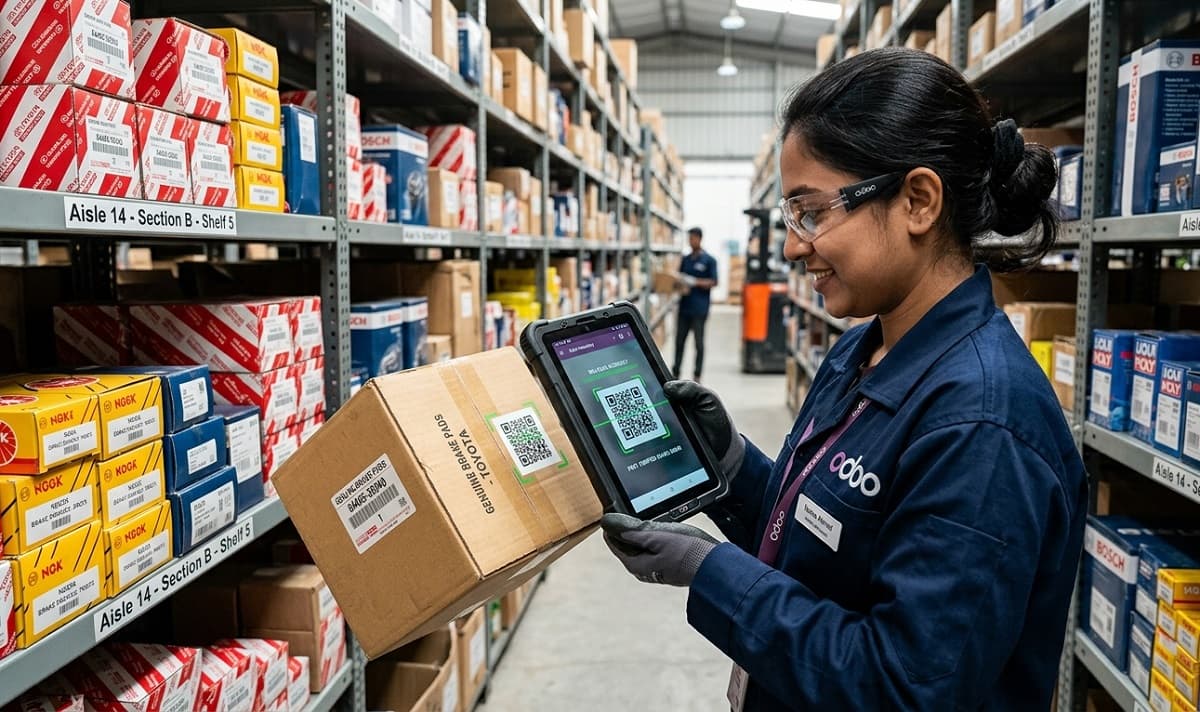
Instant Visibility: Your counter staff can see exactly where the part is (Aisle 14, Shelf B) and if there are more coming in on a truck today.
5. Multi-Step Routing: Speed with Accuracy
When you are moving 1,000 orders a day across 50,000 SKUs, "One-Step Shipping" leads to errors. A "Pick-Pack-Ship" workflow is essential.
Optimizing the Flow:
With Odoo’s Multi-Step Routes, we can design a warehouse flow that minimizes walking time (the #1 cost in any warehouse).
Batch Picking: A picker goes out once and picks parts for 10 different orders.
Packing & QC: A second person verifies the parts against the order—critical in auto parts where a "left" mirror looks very much like a "right" mirror to the untrained eye.
Shipping: Automated label generation for local delivery or international freight.
6. The Veteran’s Take: Managing a Business, Not a Museum
After 10 years, I can tell you this: The software is only as good as the strategy behind it. Implementing Odoo for a 50,000 SKU operation isn't about "installing an app." It's about cleaning your data, mapping your warehouse routes, and training your team to trust the system.
If your ERP doesn't give you a real-time dashboard showing your Stock Turn Ratio (how fast you're moving inventory) and your GMROI (Gross Margin Return on Investment), you are flying blind. In the parts business, your profit is literally sitting on your shelves. If that inventory stays still for too long, it’s not an asset—it’s a liability.
Is Your Engine Ready?
The transition from a legacy "museum" to a high-performance Odoo-powered machine takes effort, but the ROI is undeniable. You'll see fewer stockouts, less dead stock, and most importantly, happier customers who trust that when you say "we have it," you actually do.
Are you ready to stop counting parts and start scaling your business? Let's talk about building your 2026 Odoo roadmap.
Frequently Asked Questions (FAQ)
-
Does Odoo cover automotive-specific needs like VIN decoding? Odoo can be integrated with external VIN databases to decode vehicle information, allowing for precise part matching and customer service.
-
How does Odoo handle part compatibility (Fitment Data)? By utilizing Odoo’s flexible Product Attributes and Variants, we create a relational web that links parts to specific vehicle makes, models, and years.
-
Can Odoo manage thousands of OEM cross-references? Yes. Odoo allows you to link a single internal SKU to multiple OEM part numbers and aftermarket alternatives for seamless searching.
-
What is "Part Supersession" in Odoo? It's the process of tracking when a part is replaced by a newer version. Odoo automatically flags old stock for clearance and redirects new orders to the current part number.
-
How does Odoo's AI help with seasonal inventory? Odoo 19’s AI reordering rules analyze historical seasonal trends (like the monsoon season) and supplier lead times to suggest optimal stock levels.
-
Does the POS update inventory in real-time for wholesale orders? Yes. Since Odoo is fully integrated, a part reserved in a wholesale quote or scanned at the retail counter is instantly updated across the system.
-
What are "Multi-Step Routes" in the warehouse? These are automated Pick-Pack-Ship workflows that optimize picking paths and ensure Quality Control before a part leaves the building.
-
Is Odoo scalable for businesses with 50,000+ SKUs? Absolutely. Odoo is designed to handle high transaction volumes and large databases without performance degradation.
-
How does Odoo prevent "Dead Stock"? Through proactive supersession management and dynamic reordering rules, Odoo ensures you aren't ordering parts that are no longer in demand.
-
Can I manage multiple warehouse locations with Odoo? Yes, Odoo supports multi-warehouse and multi-location tracking, giving you full visibility of stock across your entire distribution network.