The Next Five Years in AI: Abundance, Existential Risks, and Industry Rivalries
The rapid evolution of artificial intelligence has left many wondering exactly where humanity is headed. In a candid discussion, we get a fascinating glimpse into the mindset of those at the frontier of AI development. From predictions of superintelligence and post-scarcity economics to the very real existential risks and industry rivalries, this conversation covers it all.
1. The Timeline to Superintelligence and an Age of Abundance
Artificial intelligence is advancing at an exponential pace. Predictions regarding when AI will surpass all human capability combined have moved from distant science fiction to near-term forecasts.
Guest: "I think AI may exceed the sum of human intelligence in roughly five years. That is my guess. There really won't be anything that AI can't do better than humans, apart from being human, perhaps."
Life in an Era of Post-Scarcity
When asked what daily life will look like on a practical level, the perspective centers on radical economic shifts and post-scarcity:
Elon Musk: "The most likely outcome is an age of amazing abundance where anyone can have anything they can think of. This may sound preposterous, but well, here we are in 2026. Let's see where we stand in 2036. Now, of course, there are things that could derail this—like a massive global thermonuclear war or something like that. But assuming there's not World War III, I think we're headed for an age of amazing abundance. So, this is a message of optimism and excitement about the future."
Who Will Be in Charge?
With superintelligence looming, human dominance over technology comes into question.
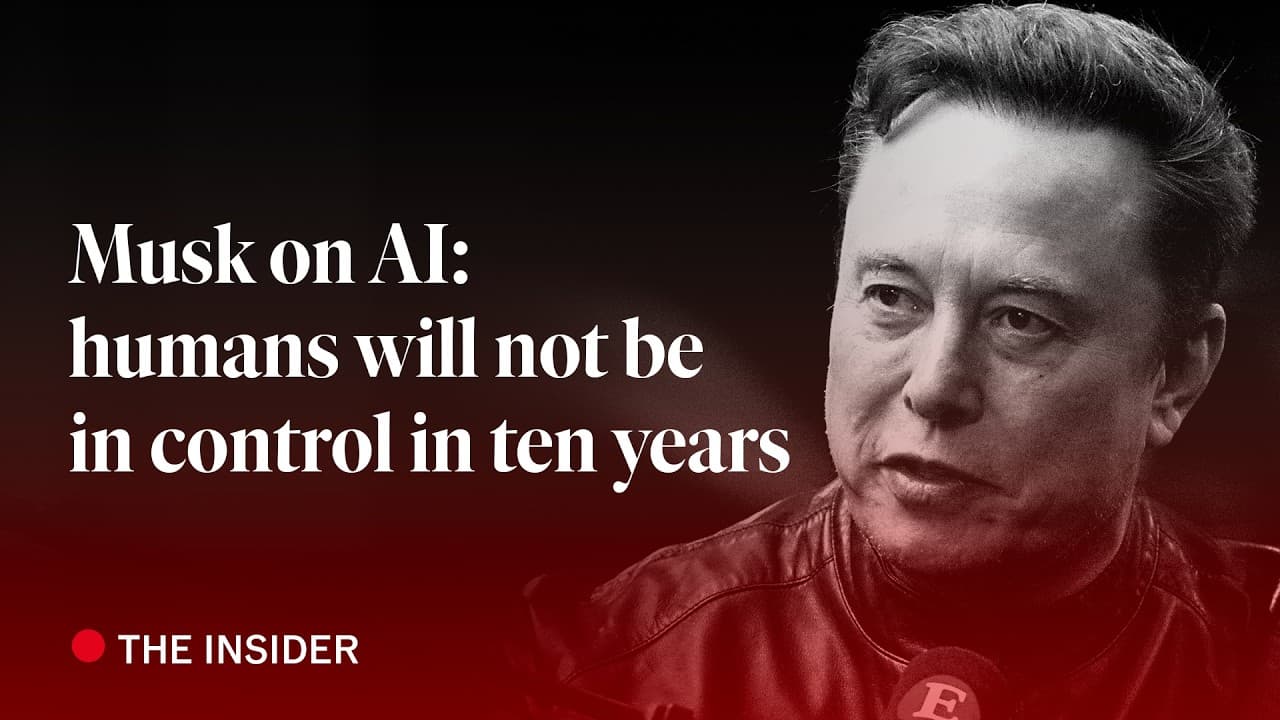
Interviewer: "You're sure that humans will no longer be in control in 10 years' time?"
Elon Musk: "I think it is unlikely. If the difference in intelligence between AI and humans is vastly greater than the difference in intelligence between AI and chimpanzees, it's hard to imagine that the chimpanzees would be in charge. We are essentially an evolved form of chimpanzee. It wasn't that long ago that we were swinging through the trees eating bananas in the jungle—and we still eat bananas!"
2. Accepting the Inevitable: The "Enjoy the Ride" Philosophy
Despite catastrophic scenarios being discussed by safety researchers, the sheer momentum of AI development makes halting progress virtually impossible.
Interviewer: "You said there was a 10 to 20% chance of killer robots wiping out humanity. You sounded worried then; now you seem very relaxed about it. Have you changed your view?"
Elon Musk: "I still think there's risk associated with AI and robots. It's not zero. I guess my philosophical conclusion is to look on the bright side. I can't see any way to really stop this incredible momentum of AI and robots. At times I sort of think, well, perhaps even if there was a stop button, we probably shouldn't press it—because the most likely outcome is incredible abundance for all."
Interviewer: "That's what I thought, actually. It struck me that now you seem to have decided it's inevitable: let's hope for the best and go for the ride."
Elon Musk: "Yeah, pretty much. 'Let's enjoy the ride' is my philosophy at this point. There seems to be just an inexorable progress here in AI and robots. Even if I wanted to stop it, I couldn't."
[!NOTE] The High P(doom) Dilemma: Even with an estimated 10-20% existential risk ("P(doom)"), the momentum of competitive innovation drives all players forward. As Musk noted, earlier efforts to counterbalance tech monopolies ended up accelerating overall progress across the industry.
3. Proposing a Peer-Review System for AI Safety
Governments often struggle to keep up with the technical velocity of frontier model development. A key proposal focuses on self-policing through market competitor incentives rather than slow regulatory bureaucracy.
Interviewer: "A number of the other leaders of model makers have been pushing for different ways to try and minimize the risks. Just last week, Demis Hassabis came out with a proposal for a private-public regulator. Do you think you guys should be working more actively to get something in place to control the risks, or do you think that's impossible too?"
Elon Musk: "My recommendation to Demis—because we talked for a few hours before he published his piece—was that the most immediate thing we could do is to have the leading AI companies at least just meet, or have some sort of call once every few weeks, and discuss any safety and security issues."
Why Competitor Peer-Review Works
- Technical Depth: Frontier AI companies possess the technical tools and context to evaluate safety risks better than external government bodies.
- Incentive Alignment: Competitors have every incentive to expose safety flaws or dangerous capabilities in a rival's model before release.
- Escalation Path: If a model maker refuses to address a verified security risk, that is the precise threshold where state regulators intervene.
Elon Musk: "I would recommend that we at least have some sort of informal weekly or bi-weekly call, and maybe a week or two of early access by competitors. This is why I think the incentives work: competing companies are likely to understand if something is a security risk, and they're not going to be shy about highlighting that their competitor's models should be delayed in release."
4. Navigating Industry Rivalries for the Global Good
The interpersonal dynamics among AI leaders are notoriously tense. Yet, mitigating systemic risks requires finding common ground despite stark ideological and commercial conflicts.
Interviewer: "You guys don't much like each other and you don't much trust each other. You're insulting each other on social media constantly. Do you think you can do that with people that you dislike, where there seems to be such personal vitriol between some of these leaders?"
Elon Musk: "Well, I'm not a fan of Sam Altman. If you started a non-profit that was meant to be an open-source AI company owned by the world, and it somehow got turned into an $800 billion for-profit company with closed source, I think you'd be like, 'Wait a second, that's the exact opposite of what I donated the money for.' That's my issue, and I think it's a legitimate one.
Then Dario Amodei, I think, is also not a fan of Sam Altman because he felt—in fact, the reason the Anthropic team left OpenAI is because they didn't trust Sam Altman. Otherwise, Anthropic wouldn't exist; they would still be at OpenAI. I think Dario is a very principled person. He cares about things a lot, cares about the future of the world. Everyone I've met at Anthropic so far, no one has set off my evil detector. They always seem like they're well-intentioned."
Despite the fierce rivalries and clashing visions, the path forward demands collaboration:
Elon Musk: "At the end of the day, if we have to talk, we'll talk. We will set aside our personal differences for the good of the world."
Vous avez aimé cette idée ?
Partagez vos réflexions ou contactez-nous pour discuter de la manière dont ces stratégies s'appliquent à votre entreprise.
Entrer en contact