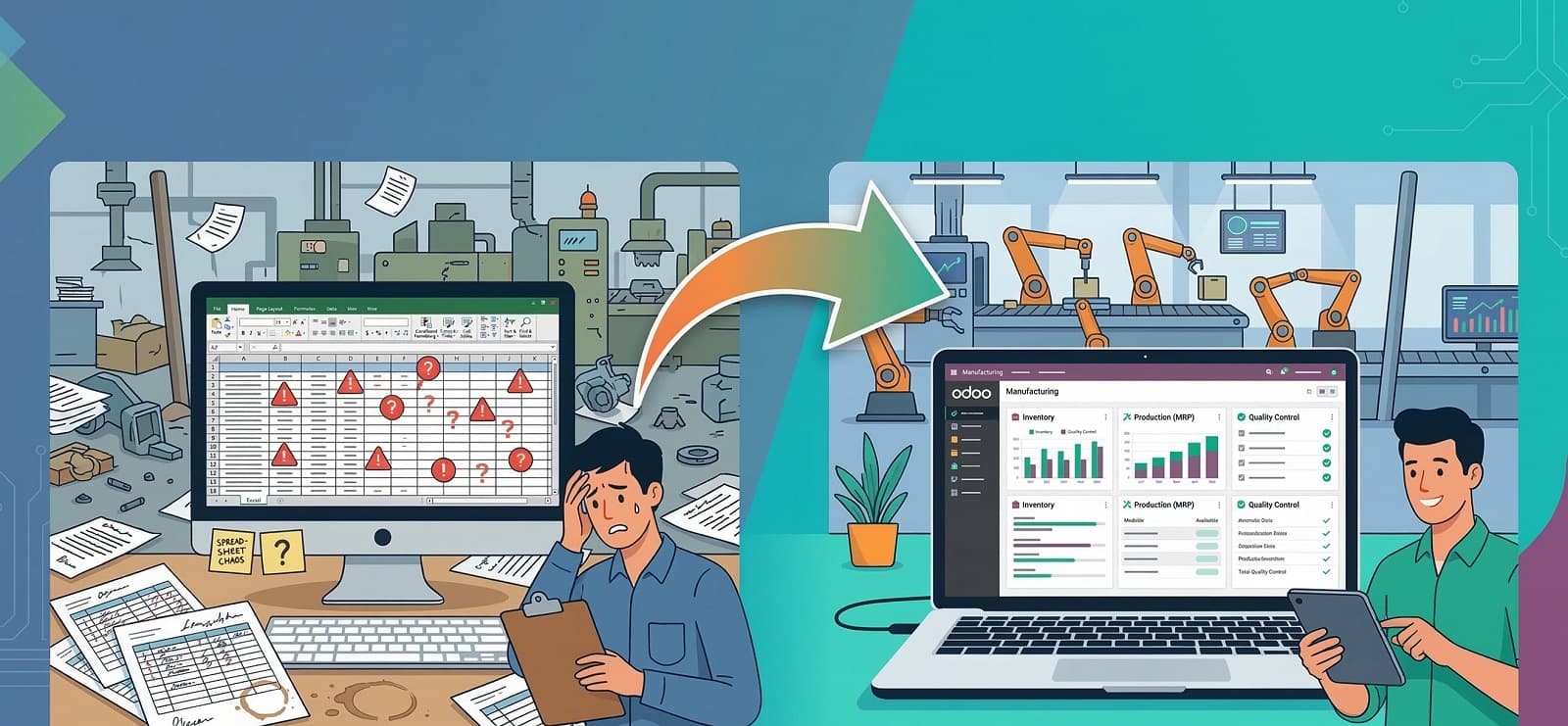
From Excel to Odoo: How to Eliminate Data Errors in Manufacturing

In virtually any manufacturing firm, you will come across spreadsheets everywhere. We see them used for tracking hours, jobs, and schedule posting—you name it.
Spreadsheets monitor inventory levels, manufacturing plans, supplier pricing, demand forecasts, and quality assurance. Most of these start with good intentions: a team member needs a fast way to monitor information, so they open Microsoft Excel, construct a table, attach some formulas, and send it to the group.
Gradually, those spreadsheets multiply. New versions appear. Columns are added. Files are emailed back and forth. At some point, critical operations become dependent on spreadsheets that nobody fully understands anymore. This is "spreadsheet creep," and it has become the invisible workhorse for many manufacturers.
However, while they are familiar and flexible, spreadsheets carry hidden costs that increase exponentially as a company grows.
Why Spreadsheets are the Default in Manufacturing
Spreadsheets aren’t inherently bad; they are one of the most versatile business instruments ever created. They are easy to build, flexible, cheap, and accessible to everyone in the organization.
For small manufacturers or startups, spreadsheets bridge the gaps between disconnected systems. Teams use them to:
- Manage Bills of Materials (BOM)
- Follow purchase orders
- Estimate production costs
- Organize daily scheduling
In most cases, the spreadsheet serves as a "patch" for software systems that don't talk to each other. The issue is that a temporary solution often lasts a decade. As complexity increases, these manual patches eventually break.
The 94% Problem: Human Error in Data Entry
One of the largest risks in spreadsheet-based operations is simple human error. Studies consistently show that spreadsheet errors are incredibly prevalent. In fact, research into spreadsheet quality reveals that 94% of business spreadsheets used for decision-making contain errors.
These mistakes take many forms, including:
- Incorrect formulas
- Broken cell references
- Copy-paste mistakes
- Manual data entry errors
- Reusing outdated data
In a manufacturing setting where margins are thin, even a minor mistake can trickle down into production planning or pricing calculations. Some operational audits have found spreadsheet errors that impacted financial systems by tens of millions of dollars.
The Search for "One Version of the Truth"
The second major problem with spreadsheet-based workflows is the lack of a unified source of truth. It is typical for different teams to maintain their own isolated files:
- Procurement tracks suppliers.
- Production tracks work orders.
- Finance follows cost estimations.
- Sales tracks forecasts.
When these files aren't synchronized, the organization ends up with multiple "truths." A production planner might see one inventory number, while purchasing sees another. Decisions are then made using outdated or incomplete information, leading to overproduction, missed delivery schedules, and wasted time spent reconciling data.
When Spreadsheets Reach Their Breaking Point
As a company grows, manufacturing systems become more complex. You move from a few products to hundreds of SKUs, global suppliers, multi-level BOMs, and strict traceability requirements.
Spreadsheets simply cannot handle this level of complexity. Large files become slow, hard to maintain, and lack critical features like:
- Data validation
- Version control
- Audit trails
- Live connectivity with other systems
For manufacturers in regulated or highly competitive industries, these restrictions become a grave operational risk.
The Human Bottleneck
There is also the "Key Person" risk. Almost every company has one individual who "owns" a critical spreadsheet. They built the formulas and understand how the numbers relate. If that person goes on vacation or leaves the company, the knowledge disappears, creating a single point of failure.
This is exactly what we aim to eliminate with Odoo. It’s not about replacing people with computers; it’s about ensuring that your team can take a much-needed holiday without the fear that the company’s data will collapse in their absence.
Transitioning to Integrated Manufacturing Systems
The goal isn't necessarily to banish spreadsheets forever—they are still great for quick analysis and experimenting. The goal is to ensure your core business processes do not rely on isolated files.
Modern ERP systems like Odoo centralize manufacturing data into a single environment. Instead of independent files, your inventory, procurement, and production planning work in sync.
Key benefits of an integrated system include:
- A single source of real-time operating information.
- Automated workflows between departments.
- Total visibility into inventory and production.
- Improved traceability and reporting.
Success Story: Mobilia Factory
Consider Mobilia Factory, the manufacturing plant for Hadaya Mall. Before implementing Odoo, they used an assortment of disconnected systems, making it difficult to track production, inventory, and costs.
By integrating Odoo, they gained a clear, real-time view of all production processes. This accuracy allowed the team to plan better, negotiate contracts with more assurance, and make informed decisions on budgeting and pricing. You can read their full success story here.
Recognizing the Warning Signs
Spreadsheets usually work fine... right up until they fail without warning. Typical indicators that you’ve outgrown your spreadsheet workflows include:
- Teams wasting hours reconciling conflicting data.
- Production delays caused by inaccurate inventory data.
- An increasing reliance on manual, repetitive processes.
- Difficulty scaling or adding new product lines.
Manufacturing success depends on efficiency, precision, and coordination. While spreadsheets are powerful, they weren't designed to handle the dynamics of modern manufacturing. The first step toward a more resilient, scalable business is realizing it's time to grow out of the cell and into a system.
Vous avez aimé cette idée ?
Partagez vos réflexions ou contactez-nous pour discuter de la manière dont ces stratégies s'appliquent à votre entreprise.
Entrer en contact