
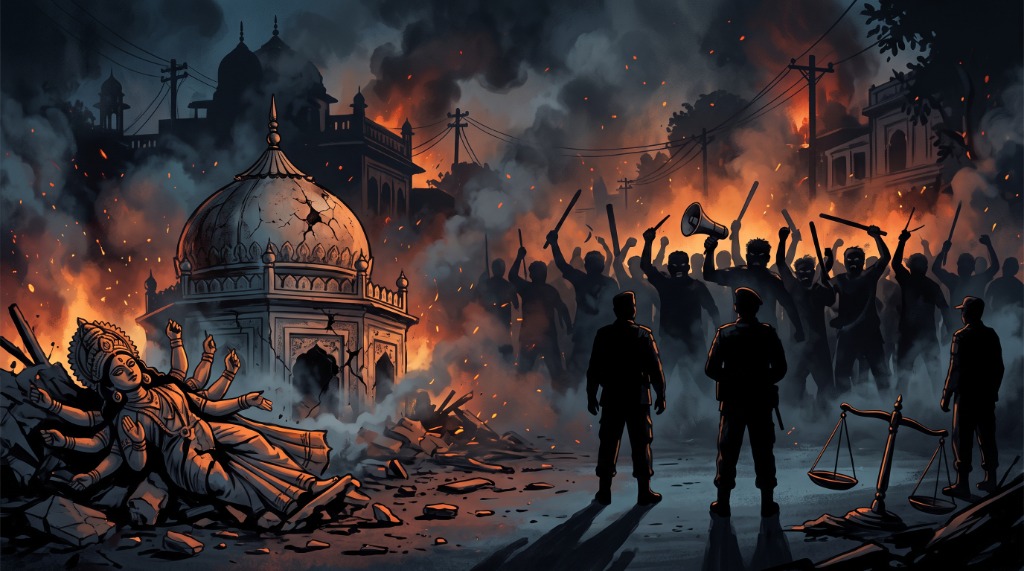
Religious Extremism, Mob Violence, and State Silence: Dissecting Bangladesh's Constitutional & Social Crisis (2024–2026)
Report Period: January 1, 2024 – October 21, 2026
Data Sources: Documented investigative reports in Bangladeshi national media, verified data releases from human rights monitoring organizations, and academic analyses.
Central Inquiry: Why do religious frenzy and mob violence recur without formal state sponsorship—and even under the physical presence of law enforcement—and at what systemic friction points does accountability dissolve?
Executive Summary
Between January 2024 and October 2026, two distinct yet interconnected trajectories of collective violence unfolded across Bangladesh. The first is sanctuary-targeted attacks and desecrations—ranging from minority Hindu temples and deities to historic Sufi shrines (mazars), spiritual lodges (darbars), and Baul hermitages. The second is mob lynchings and vigilante killings, predominantly triggered by allegations of blasphemy or criminal suspicion.
Both trajectories underwent structural mutations following the political regime change of August 5, 2024. Between August 4 and August 20, 2024 alone, the Bangladesh Hindu Buddhist Christian Unity Council documented 2,010 incidents of communal violence, resulting in 9 fatalities and attacks on 69 places of worship. In the subsequent two years, Sufi shrines became systematic targets: research organization Maqam confirmed attacks on 97 shrines across 17 months (August 2024 – December 2025).
Simultaneously, the fatal curve of mob lynching accelerated sharply. In 2025, human rights monitor HRSS documented 168 deaths in 292 incidents of mob violence; in the first nine months of 2026 alone, that death toll rose to 187 across 398 incidents. Rather than subsiding, the violence metastasized. The central thesis of this report: following every major atrocity, the state generates administrative reaction, but systematically withholds structural accountability. Arrest announcements, police reports, and fact-finding committees are routinely staged, but the legal chain breaks down at causal determination, judicial velocity, and the prosecution of ideological instigators.
1. Definitional Framework
1.1 Religious Extremism & Frenzy
In sociological and psychological literature, extremism is understood not merely as violent tactics, but as severe, intolerant adherence to ideological dogma. A prominent psychological review defines extremism as having rigid prescriptive norms regarding permissible behavior, combined with near-zero tolerance for alternative practices or beliefs [45].
Within this report, religious extremism denotes treating specific theological interpretations as absolute, unalterable criteria, refusing to tolerate divergent theological traditions or minority beliefs, and converting that intolerance into perceived moral authorization to suppress or punish others. When organized into collective physical assault, it constitutes violent religious extremism.
"Frenzy" (Unmadona) is utilized here as an analytical category rather than a statutory term. It captures collective emotional agitation wherein critical verification, evidentiary standards, and proportionality vanish—and a crowd instantly converts an unverified allegation into a summary execution sentence.
1.2 Mob Violence & Vigilante Justice ("Mob Justice")
The colloquial phrase "mob justice" represents a dangerous misnomer: an unruly crowd taking the law into its own hands to administer immediate, collective punishment [42]. As defined by the Justice Centres of Uganda, mob justice constitutes "punishing or retaliating against a suspect through humiliation, assault, murder, or property destruction before any lawful adjudication" [42].
In this report, mob violence is characterized by four empirical indicators:
- Suspicion Treated as Conclusive Proof: Rumors, viral Facebook posts, or loudspeaker calls replace formal evidence;
- Hyper-Publicity: Orchestrated in broad daylight in public bazaars, outside shrines, police stations, or hospitals, often recorded on smartphones;
- Execution Despite State Presence: Violence proceeds uninhibited even when police, paramilitary, or military units are physically deployed on site;
- Lethal Intent: Aimed at physical elimination or incapacitating brutality rather than mere dispersal.
2. Methodology & Limitations
This investigation compiles verified national media reports, independent fact-checks, and statistical releases from human rights bodies:
- Disparities in Organizational Datasets: Differing organizations employ varied recording methodologies. The Unity Council recorded 2,010 communal incidents between August 4–20, 2024 [2], whereas Prothom Alo's nationwide field investigation identified 1,068 damaged minority homes and businesses between August 5–20 [1]. This statistical divergence itself highlights the absence of an institutional, centralized state monitoring system.
- Viral Misinformation and Weaponized Rumors: Research group Maqam verified that out of 134 reported shrine attacks, 97 were physically substantiated, 37 lacked verified evidence, and 6 were complete fabrications/rumors [30].
- Under-Reporting: In rural areas, attacks on minor village shrines and temple desecrations frequently culminate merely in non-cognizable General Diaries (GD) rather than formal First Information Reports (FIRs) [33].
3. Chronological Trajectory: January 2024 – October 2026
3.1 Pre-Transition: January – July 2024
During this period, mob killings and desecration showed alarming warning signs:
- February 2024: 14 Hindu temple idols smashed in a single night across three unions in Baliadangi, Thakurgaon [4].
- April 19, 2024: In Madhukhali, Faridpur, two construction workers were lynched inside a school after rumors spread that they had set fire to a Hindu temple idol [5].
3.2 August 2024: Regime Collapse and Communal Shockwaves
The fall of the Sheikh Hasina administration on August 5 triggered an acute institutional vacuum:
- August 4–20, 2024: 2,010 communal incidents recorded; 9 fatalities, 4 sexual assaults, 69 religious sites desecrated, 915 households and 953 commercial enterprises looted, damaged, or arsoned [2].
- August 5, 2024: Hindu Buddhist Christian Unity Council reported coordinated attacks across 29 districts within the initial 24 hours of state police withdrawal [3].
3.3 Late 2024: The Wave of Shrine Demolitions & The Chinmoy Crisis
In autumn 2024, religious agitation pivoted sharply toward Sufi traditions:
- September 6, 2024: Dewanbagh Pir's darbar in Bandar, Narayanganj attacked and set ablaze following public mosque announcements after Fajr prayers [6].
- September 10, 2024: Clashes at the historic Hazrat Shah Paran shrine in Sylhet during the annual Urs festival, leaving 20 injured [7].
- September 11, 2024: Buchai Pagla's shrine in Dhamrai, Dhaka flattened using heavy hydraulic excavators (backhoes) by organized theological groups citing "anti-Islamic practices" [8].
- November 25–29, 2024: Arrest of Hindu monk Chinmoy Krishna Das Brahmachari in Dhaka [46], followed by the brutal killing of government prosecutor Saiful Islam Alif outside the Chittagong court complex [47].
3.4 2025: Institutionalization of Vigilantism
- January 18, 2025: The Chief Adviser's Press Wing confirmed that within 5.5 months following August 4, 40 shrines had suffered 44 separate attacks, yielding only 23 arrests [13].
- February 20, 2025: In Kaladrap, Noakhali, attackers vandalized a shrine during its annual Urs in direct defiance and physical sight of deployed military and police personnel [16].
- September 5, 2025: In Goalanda, Rajbari, a mob besieged Nural Pagla's shrine following Friday prayers, disinterred a buried corpse, and burned it in the street, injuring dozens of law enforcement officers [20][21].
- September 18, 2025: In Homna, Comilla, announcements over mosque loudspeakers mobilized a mob that attacked, ransacked, and burned four Sufi shrines within a single hour following an alleged blasphemous Facebook post [24].
- November 20, 2025: Renowned folk Baul singer Abul Sarkar arrested and jailed under blasphemy laws after clips from a traditional musical performance were weaponized online [27].
3.5 2026: Escalation & Normalization
- April 11, 2026: In Daulatpur, Kushtia, Sufi Pir Shamim Reza was lynched inside his hermitage following the circulation of a years-old video on social media; the Superintendent of Police publicly admitted that police were outnumbered by the mob and unable to intervene [31].
- May 15–16, 2026: Organized attack on devotees at the historic Shah Ali shrine in Mirpur, Dhaka [32].
- September 20, 2026: Attack inside a Durga Puja pavilion in Balaganj, Sylhet, where an individual chopped temple idols with a cleaver [36].
- October 14–16, 2026: In Debhata, Satkhira, Wahiduzzaman Shamim was beaten to death over blasphemy allegations, assaulted a second time even after being brought to a hospital; the primary accused remained active on social media while evading arrest [39][40].
- October 19, 2026: HRSS reported that during the first 9 months of 2026, mob violence claimed 187 lives across 398 incidents—surpassing the total for the entire previous year [41].
4. Analytical Patterns: One Violence, Three Typologies
4.1 The Three Targets of Ideological Assault
- Desecration of Minority Temples: Rooted in local land disputes, economic predation, and theological chauvinism.
- Anti-Shrine (Mazar) Demolitions: The most ideologically structured form of violence in post-August Bangladesh. The targets here are not religious minorities, but fellow Muslims adhering to indigenous syncretic, Sufi, or mystical traditions.
- Blasphemy-Triggered Lynchings: The deadliest category. A digital spark—often an unverified screenshot, old video, or manufactured rumor—is converted via loudspeakers into instantaneous public execution.
4.2 The Mechanics of Mobilization: Microphones, Facebook & Manufactured Rumors
The anatomy of escalation relies on three recurring instruments:
- Loudspeaker Announcements: Utilizing neighborhood mosque loudspeakers to summon crowds within minutes [6][24].
- Algorithmic Amplification: Facebook posts, livestreams, and weaponized video snippets [24][31][40].
- Rumor Ecosystems: Fabricated narratives that spread uncontested before factual verifications can emerge [30].
5. State Silence: Six Structural Forms of Impunity
The term "silence" does not imply total administrative inactivity. The state issues press statements, logs cases, and makes occasional arrests. The silence lies in six systemic failures:
- The Chasm Between Cases and Convictions: In 44 shrine attacks across 5.5 months, only 23 suspects were detained [13]. Instigators of loudspeaker mobilization frequently remain untouched [25].
- Burdening the Victims with Prosecution: Families of victims must navigate immense intimidation before filing court petitions weeks or months later [23].
- Paralysis in the Presence of Law Enforcement: Attacks in Noakhali [16], Rajbari [20], and Kushtia [31] proceeded despite police presence, exposing a catastrophic unwillingness or incapacity of commanders to confront mobilized theological crowds.
- Euphemistic Relabeling: Labeling attacks as "internal rivalry," "disputes over donations," or "purely political" obscures the ideological and organizational machinery behind religious extremism [14][38].
- High-Level Rhetoric vs. Institutional Vacuum: Cabinet warnings produce no judicial commissions or compensation funds [15][34][44].
- Selective Velocity of Law Enforcement: Decisive police action occurs only when incidents threaten urban political stability, leaving rural minorities and Sufi shrines vulnerable [32].
6. Policy Imperatives
- Unified National Registry: Establish an independent, publicly accessible statutory registry of communal attacks, shrine desecrations, and mob lynchings.
- Criminalizing Public Incitement: Treat public loudspeaker mobilization and digital incitement as principal conspiratorial offenses rather than secondary misdemeanors.
- Command Accountability: Mandate administrative inquiries into field law enforcement detachments that fail to protect victims in their physical presence.
- Digital Platform Accountability: Institute strict regulatory mechanisms holding social media corporations accountable for viral incitement content remaining active during ongoing mob violence [40].
Conclusion
Between 2024 and 2026, religious violence in Bangladesh transformed across multiple iterations—from communal unrest in August 2024 to sustained anti-shrine demolitions in 2025, and systemic blasphemy lynchings in 2026. Yet the underlying template remains unchanged: an accusation, an amplified broadcast, an assembling crowd, and an unresolved criminal trial.
Until religious frenzy ceases to be treated merely as moral delinquency and mob violence as a routine policing failure, the political economy of hatred—who organizes, who benefits, and who enjoys systemic immunity—will continue to claim lives across Bangladesh.
References
[1] Prothom Alo, "Aug 5–20: Damaged Minority Homes and Businesses Total 1,068", Sept 12, 2024.
[2] Prothom Alo, "9 Killed in 2,010 Incidents of Communal Violence: Unity Council", Sept 2024.
[3] Prothom Alo, "Communal Attacks in 29 Districts: Unity Council", Aug 5, 2024.
[4] Bhorer Kagoj, "14 Temple Idols Desecrated in a Single Night in Thakurgaon", Feb 2024.
[5] Prothom Alo, "Two Lynched in Madhukhali Over Suspected Temple Arson", Apr 19, 2024.
[6] Prothom Alo, "Dewanbagh Pir's Darbar Vandalized and Burned in Narayanganj", Sept 6, 2024.
[7] Prothom Alo, "Midnight Clashes at Hazrat Shah Paran Shrine, 20 Injured", Sept 10, 2024.
[8] Prothom Alo, "Buchai Pagla's Shrine Razed with Excavators in Dhamrai", Sept 11, 2024.
[9] Prothom Alo, "12 Incidents of Shrine Attacks and Arson in September: MSF", Oct 1, 2024.
[10] Prothom Alo, "Murshidpur Pir's Darbar Attacked in Sherpur, 13 Injured", Nov 26, 2024.
[11] Prothom Alo, "Demands to Ban ISKCON and Hang Lawyer's Killers", Nov 29, 2024.
[12] Prothom Alo, "Attack on Qawwali Event and 200-Year-Old Shrine in Mymensingh", Jan 9, 2025.
[13] Prothom Alo, "40 Shrines Attacked 44 Times in 5.5 Months, 23 Arrested: Press Wing", Jan 18, 2025.
[14] Prothom Alo, "98% of Minority Attacks Politically Motivated: Police Inquiry", Jan 11, 2025.
[15] Prothom Alo, "80 Shrines Attacked in 6 Months, Judicial Commission Demanded", Jan 23, 2025.
[16] Prothom Alo, "Shrine Vandalized in Front of Police and Army in Noakhali", Feb 20, 2025.
[17] Prothom Alo, "Extensive Looting After Arson at Ghoraghat Shrine", Mar 1, 2025.
[18] Prothom Alo, "Midnight Attack on Ismail Shah Shrine in Barguna, 20 Injured", Mar 17, 2025.
[19] Prothom Alo, "Mob Lynchings on the Rise: 119 Killed in 7 Months", Mar 5, 2025.
[20] Prothom Alo, "Nural Pagla's Shrine Vandalized and Set on Fire in Rajbari", Sept 5, 2025.
[21] Prothom Alo, "One Dead in Attack on Nural Pagla Shrine in Rajbari", Sept 5, 2025.
[22] Prothom Alo, "Tense Atmosphere at Nural Pagla's Shrine, Family Too Afraid to File FIR", Sept 6, 2025.
[23] Prothom Alo, "Family Files Court Case Two Months After Rajbari Shrine Desecration", Nov 2025.
[24] Prothom Alo, "Four Shrines Attacked in Comilla Within One Hour via Mosque Loudspeakers", Sept 18, 2025.
[25] Prothom Alo, "Comilla Shrine Attacks: Instigators Remain at Large", Sept 20, 2025.
[26] Prothom Alo, "150 Injured in Clashes Triggered by Facebook Post in Hathazari", Sept 7, 2025.
[27] Prothom Alo, "Baul Artist Abul Sarkar Jailed Over Blasphemy Allegations", Nov 20, 2025.
[28] Prothom Alo, "73 Blasphemy Incidents Against Minorities in 11 Months: HRCBM", Dec 1, 2025.
[29] Prothom Alo, "168 Killed in 292 Mob Violence Incidents in 2025: HRSS Annual Report", Jan 1, 2026.
[30] Prothom Alo, "97 Shrines Attacked Across 17 Months: Maqam", Feb 2, 2026.
[31] Prothom Alo, "Sufi Pir Lynched and Burned in Kushtia Shrine", Apr 11, 2026.
[32] Prothom Alo, "Three Arrested via CCTV Footage After Shah Ali Shrine Attack", May 16, 2026.
[33] Prothom Alo, "Kali Temple Idols Desecrated in Tarakanda, Mymensingh", Jun 26, 2026.
[34] Prothom Alo, "6 Shrines Attacked in First Half of 2026: Maqam", Jul 2, 2026.
[35] Prothom Alo, "23 Detained Under Suspicion of Extremism from Tejgaon College Mosque", Sept 18, 2026.
[36] bdnews24.com, "Youth Arrested After Chopping Idols in Balaganj Puja Pavilion", Sept 20, 2026.
[37] The Daily Star, "34 Incidents of Temple Desecration Prior to Durga Puja", Oct 14, 2026.
[38] Jago News 24, "Police Claim No Communal Motive in 34 Pre-Puja Incidents", Oct 19, 2026.
[39] Prothom Alo, "Two Arrested for Satkhira Lynching; Prime Accused Still Active on Facebook", Oct 16, 2026.
[40] Prothom Alo (Op-Ed), "Will Meta Escape Accountability for Lynchings Fueled on Facebook?", Oct 19, 2026.
[41] Prothom Alo, "187 Killed in Mob Lynchings in First 9 Months of 2026: HRSS", Oct 19, 2026.
[42] Prothom Alo, "What Is Mob Justice and Its History?", 2024.
[43] Prothom Alo, "Temple Idols Damaged in Kushtia Under Cover of Darkness", Oct 9, 2026.
[44] Daily Bhorer Dak, "We Will Not Sit Idle if Shrines are Destroyed: State Minister Azad", Aug 26, 2026.
[45] Wibisono, Louis & Jetten, "A Multidimensional Analysis of Religious Extremism", Frontiers in Psychology, 2019.
[46] Prothom Alo, "Chinmoy Krishna Das Arrested at Airport", Nov 25, 2024.
[47] Prothom Alo, "Arrests in Chittagong Prosecutor Saiful Islam Alif Murder", Nov 2024.
Hat Ihnen dieser Einblick gefallen?
Teilen Sie Ihre Gedanken mit oder kontaktieren Sie uns, um zu besprechen, wie diese Strategien auf Ihr Unternehmen anwendbar sind.
Nehmen Sie Kontakt auf