Money Won't Matter in 2036: Elon Musk's Predictions for the Age of Abundance
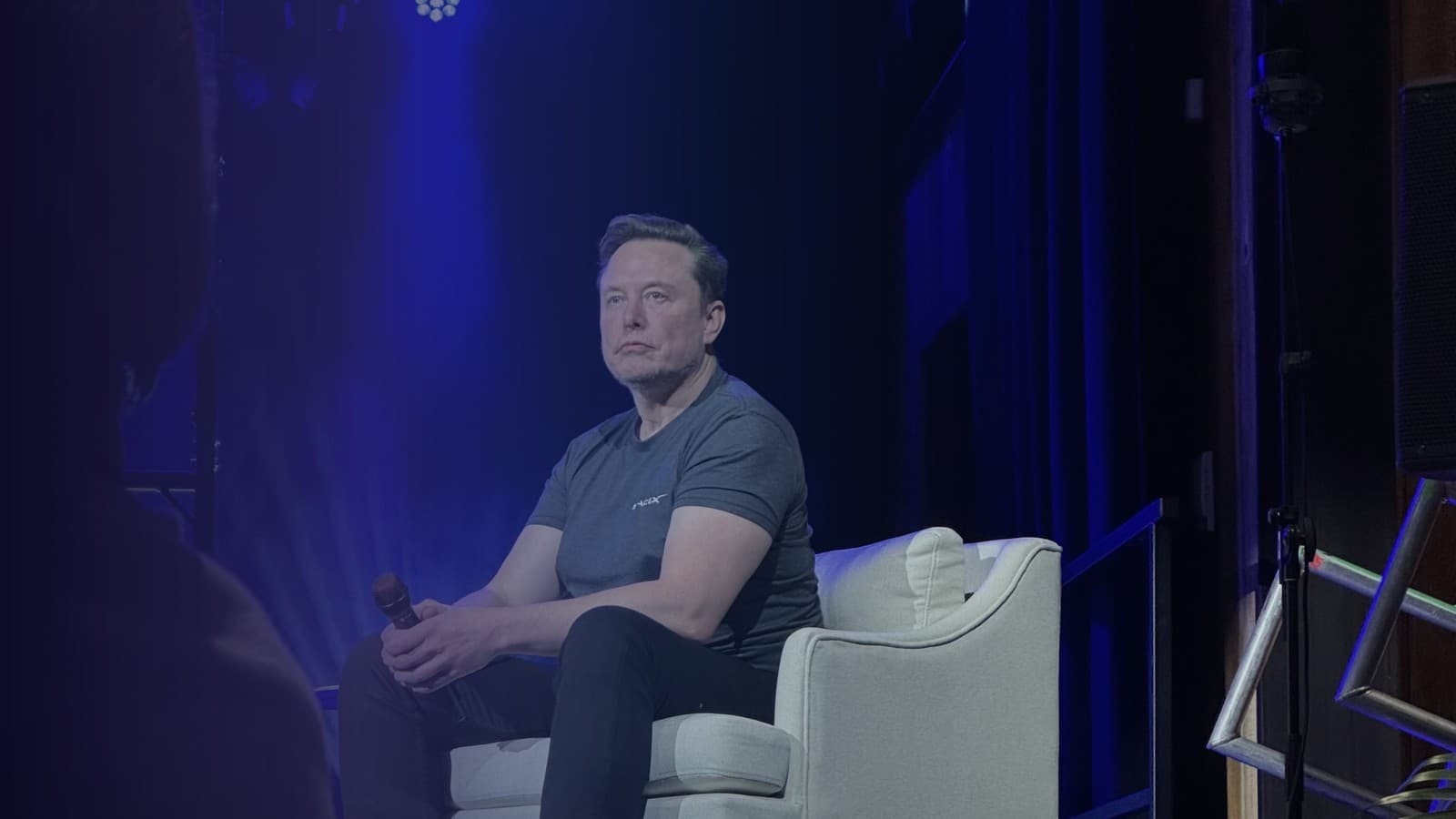
In an 85-minute interview recorded at Tesla's Gigafactory, The Economist asked Elon Musk to put the pieces together: electric vehicles, space travel, a frontier AI model, humanoid robots. It was one of his most wide-ranging conversations in years — techno-optimist manifesto, safety proposal, and political argument in one. Here is the interview, in full.
Superintelligence Within Five Years
Asked what the world looks like in 2036 if he succeeds, Musk did not hesitate. "It's hard to imagine a future where there's not an overall overwhelming amount of artificial intelligence," he said; in ten years AI will be "far greater than the sum of human intelligence. Far greater." He pushed the timeline further: within five years.
The most likely outcome, he said, is "an age of amazing abundance, where anyone can have anything they can think of." It sounds preposterous, he acknowledged — but "here we are in 2026," and he invited the interviewer to check back in 2036. The main risk: a massive global thermonuclear war. Assuming no World War III, his message is "optimism and excitement about the future."
The Quasi-Infinite Economy and the End of Money
Pressed on how his companies will make money in ten years — the SpaceX prospectus seemed to show most revenue coming from AI, not space transport — Musk reframed the question. Think of the economy as digital and physical intelligence. Digital intelligence advances almost weekly, but it is "somewhat confined to the digital realm": it has no end effectors. "You need lots of bots, in a nutshell." With humanoid robots managed by large AI models, intelligence starts shaping atoms rather than only appearing digitally. An economy is the production of goods and provision of services; vast robots plus vast digital intelligence add up to "a quasi-infinite economy."
Then came the framing prediction: "Money won't matter in 2036." People want money for goods and services — food, housing, transport, entertainment; if robots provide more than any human could consume, money becomes unnecessary. To the economist's objection that printing checks causes inflation, Musk answered that inflation is the ratio of money to goods and services: if output rises dramatically, the money supply can rise with it. "I'll make a prediction: deflation will be the issue, not inflation." His advice for government: "The Treasury should just issue people checks."
Who's in Control?
Does Musk intend to control the superintelligence he is building? He called that idea "an exercise in vanity." The best humans can do is ensure it "has good values, that it cares about humanity, and that it wants us to be happy and prosper." The most important thing for AI safety, his "biological neural net" tells him, is that the AI be "maximally truth-seeking and curious."
Will humans still be in control in ten years? He thinks it unlikely. "If the difference in intelligence between AI and humans is vastly greater than the difference in intelligence between AI and humans is vastly greater than the difference in intelligence between AI and chimpanzees, it's hard to imagine that the chimpanzees would be in charge." Humans are, after all, "an evolved form of chimpanzee" — and we still eat bananas and occasionally swing through trees. "There should be more swinging through trees. I bet it's way more fun than people think."
From Fear to Acceptance
The interviewer confronted Musk with his own record: ten years ago, on Neil deGrasse Tyson's podcast, he said the thing that terrified him most was recursive self-improvement in AI, predicting humans would be "pet Labradors at best"; in 2023 he signed the open letter calling for a slowdown; last year, on Ted Cruz's podcast, he put a 10 to 20 percent chance on killer robots ending humanity. Now he sounds relaxed. Changed his mind?
"The risk is not zero," Musk said, "but I've come to a philosophical conclusion to look on the bright side." He sees no way to stop the momentum — and even if there were a stop button, "we probably shouldn't press it," because the most likely outcome is abundance for all. On the doom figure, he deflected with physics: the universe ends in heat death, "a long, boring, thin, gray soup of gradual cooling. So if the heat death of the universe is in fact the outcome, then it really is all about the journey, because the destination is terrible."
He also explained his AI history: he created OpenAI as "essentially a counterweight to Google"; Anthropic then spun out of it, and "if anything, my actions have accelerated AI." His conclusion: "All roads lead to acceleration of AI. You can just sort of be sad about it, or join the club, I suppose. You can't beat them, join them."
A Safety System the Industry Hasn't Built Yet
On risk reduction, Musk was concrete. Demis Hassabis had just published a plan for a private-public regulator — a good starting point, Musk said. His own recommendation was simpler and faster: the leading AI companies should meet or call every few weeks, and before any new frontier model is released, competing companies should get a week or two of early access to test it for harmful effects via an API, with the ability to recommend pausing. Competitors, he argued, are better judges than government, which lacks deep technical understanding: "competitors have an incentive to keep the others honest." He compared it to the Motion Picture Association rating movies, with government intervention only as a backstop when a company refuses to address a danger. As a real example he cited the Mythos model: the government did not discover its cybersecurity risks — Amazon did, and Amazon called the White House.
On the obvious obstacle — the AI leaders openly dislike each other — Musk was blunt. He is "not a fan of Sam Altman": OpenAI began as a nonprofit, open-source company "owned by the world" and became, he said, an $800 billion for-profit, closed-source company, "the exact opposite of what I donated the money for." Dario Amodei is principled; the Anthropic team left OpenAI because they did not trust Altman. Still, "at the end of the day, we'll set aside our personal differences for the good of the world." The system should include the leading Chinese companies too — and time is short: "Six months is a long time," with breakthroughs "sometimes multiple per day."
The Real Constraints: Electricity and Chips
On China, Musk was measured. Chinese companies are doing remarkably well "with a relatively small amount of compute," so if they got a lot of compute, "there's a good chance they would be the leaders." The constraints on AI are essentially electricity and AI chips — and for physical AI, robots. China already produces more electricity than the United States, Europe, and India combined, and Musk guesses it will reach four times US production, roughly proportionate to population. The US can ban its companies from using Chinese models but cannot stop the rest of the world — and he does not think banning helps. China is also "closer than most people realize to solving the lithography problem," which would let it make AI chips at huge scale.
The current bottleneck outside China is power and cooling, not chips — which is why he is thinking about orbital data centers. He praised China's new Kimmy K3 as nearly as good as his own Fable, though he insisted Fable is still "clearly the smartest model."
The Bumpy Road for Jobs
On jobs, Musk agreed the transition will be "a bumpy road." AI will be able to do any job better than any person — very soon for anything digital. Software engineering is already there: "AI is better than at least 90 percent of professional software engineers," heading to 99 percent, until competition becomes pointless. He called it "Stockfish level" — the chess program so good it can beat Magnus Carlsen even on a phone. Physical jobs will follow as humanoid robots mature.
The result: "work is going to be optional." His analogy is gardening: nobody has to grow vegetables — the store has pristine ones — but a friend's dinner from a garden "is a nice touch. That's what work is going to be."
To the politics of displacement, Musk offered history: "computer" once meant a person doing calculations — entire skyscrapers full of them. Those jobs vanished; what is different now is the radically accelerated pace. He recommended Iain Banks's Culture novels as the best vision of an AI future. On redistribution: he has set the record for the most taxes ever paid by a human, expects to pay "many trillions," and is fine with it — though in a future where money is irrelevant, "taxation also becomes somewhat irrelevant." He also took SpaceX public partly so the public could own a piece of it.
Control, Key-Man Risk, and Mars
On his unusual control — after the IPO, some 80 percent of voting shares, removable only by a vote he controls — Musk said such concentration is "ever thus": Alphabet is controlled by Larry and Sergey; Zuckerberg controls Meta. He needs the control to protect a five-to-ten-year horizon against quarterly earnings pressure. The Mars program is the example: "You missed your earnings this quarter because you spent too much on Mars." Yes — and it is listed in the S1 prospectus. Asked about key-man risk, he said his companies would do well for years on clear roadmaps — citing Apple after Steve Jobs: very successful, but no Jobs-level breakthrough.
Has his attention shifted from Mars to AI? His answer was larger: he wants "the set of actions that propagate consciousness into the future to the maximum degree possible" — the Star Trek/Star Wars future (Star Wars was the first movie he saw, at six; "it blew my mind"). Starship, he noted, is the largest, most powerful flying object ever made, and he intends to launch it more than once per hour. Ray Kurzweil's forecasts, he added, have been "remarkably accurate"; the singularity is approaching.
Starlink, War, and the Power of One Individual
The conversation turned to Starlink's geopolitical power. Ukraine's government has publicly thanked Starlink for its role in defense; but Russians obtained units ordered through Ukraine and smuggled into occupied eastern Ukraine, sometimes using them for attacks, so Musk worked with Kyiv on a whitelist of approved terminals — with the downside that innocent users lost access.
Musk steered to his hope for peace: the border has barely moved for two or three years while people die daily. He is offended by "fancy diplomats" with seven-course dinners who pontificate about Russia withdrawing when "Russia's not going to withdraw." He posted years ago that there needs to be some concession to Russia — "this is not me being pro-Russia, I'm just being pragmatic" — and Ukraine is not going to retake those territories. "There are no angels in war."
On DOGE, Musk admitted: "I got a little too involved in politics, got carried away, frankly." The goal was the deficit, where interest payments now exceed the entire Department of War and intelligence budgets. Asked whether the suddenness of the cuts caused unnecessary suffering and deaths, he was categorical: "Zero. These claims are false. They're nonsense." Funding was cut from fraudulent organizations, he said; big private foundations could step in. The administration itself, he said, is "on balance excellent," "vastly better than the alternative."
The Europe Argument
The sharpest exchange concerned Europe. Musk said he supports "the normal people," not the "far right" as falsely labeled, and challenged the interviewer to find anything extreme in three principles: "secure borders, safe cities, sensible spending." He admonished the media for the "absurd characterization of the far right. It is false and misleading and nonsense. Please keep this part in."
The interviewer, who lives in London, pushed back hard: London is safer than any US city, UK violent crime is coming down, and Musk's posts — including "civil war in Britain is inevitable, just a question of when" — reach roughly 250 million followers. Musk stood by it: "If current trends continue, it is." A large, growing group whose beliefs are antithetical to Western values will eventually bring a "reckoning." He denied being racist: his partner is half Indian, they have four children, and his companies have senior executives of all races. Asked if he is anti-Muslim, he said he is against people coming to a country with antithetical views, against rape and murder, against the imposition of rules contrary to what the West accepts.
The interviewer called his blanket support of parties like the AfD dangerous — "proto-authoritarians" with "very clear fascist tendencies" in some cases — and said his interventions risk making Europe's problems worse. Musk called that "total fiction"; Europe simply needs secure borders and culturally safe integration. On migration they found common ground: both favor controlled immigration — Musk, himself an immigrant, if people will be productive, honest, and not mistreat others. But a welfare state that benefits anyone who comes, he argued, creates "a very powerful economic forcing function" for migration.
"History Will Write the Verdict"
Asked what people get most wrong about him, Musk said his political views are "very centrist," and calling them far right is "an insult to history, an insult to many peoples, and an outrageous falsehood." He then made a broader claim: "I'm very good at predicting the future. My batting average is very high for a human." The problem, he acknowledged, is a Cassandra effect — people don't believe him until it happens.
Which set does he trust more? "AI and robots will really dominate everything, on a time scale of less than ten years." His reconciliation of the two threads: "The AI-robot singularity is ten years away. Civil war in Britain is probably twenty years away." The interviewer closed by hoping that "benign, all-powerful AIs" would prevent such outcomes. "They probably will," Musk said.
Key Takeaways
- AI Singularity: Musk predicts AI beyond all human intelligence within five years, leading to "an age of amazing abundance" by 2036.
- The Deflationary Economy: Money becomes unnecessary in a quasi-infinite economy of digital intelligence plus humanoid robots — and deflation, not inflation, is the policy challenge.
- 轻量级 Industry Safety System: He proposes a lightweight industry safety system: weekly calls among frontier labs, competitor testing of new models before release, government as backstop.
- Physical Constraints: The real constraints on AI are electricity and chips, with China closer to solving the lithography problem than most realize.
- Future of Work & Geopolitics: He expects a "bumpy road" toward optional work — and insists his politics are centrist, to be vindicated by history, with the AI-robot singularity arriving before any European civil war.
Hat Ihnen dieser Einblick gefallen?
Teilen Sie Ihre Gedanken mit oder kontaktieren Sie uns, um zu besprechen, wie diese Strategien auf Ihr Unternehmen anwendbar sind.
Nehmen Sie Kontakt auf