What to Believe When Elon Musk Predicts the Future: The Fine Print of Abundance
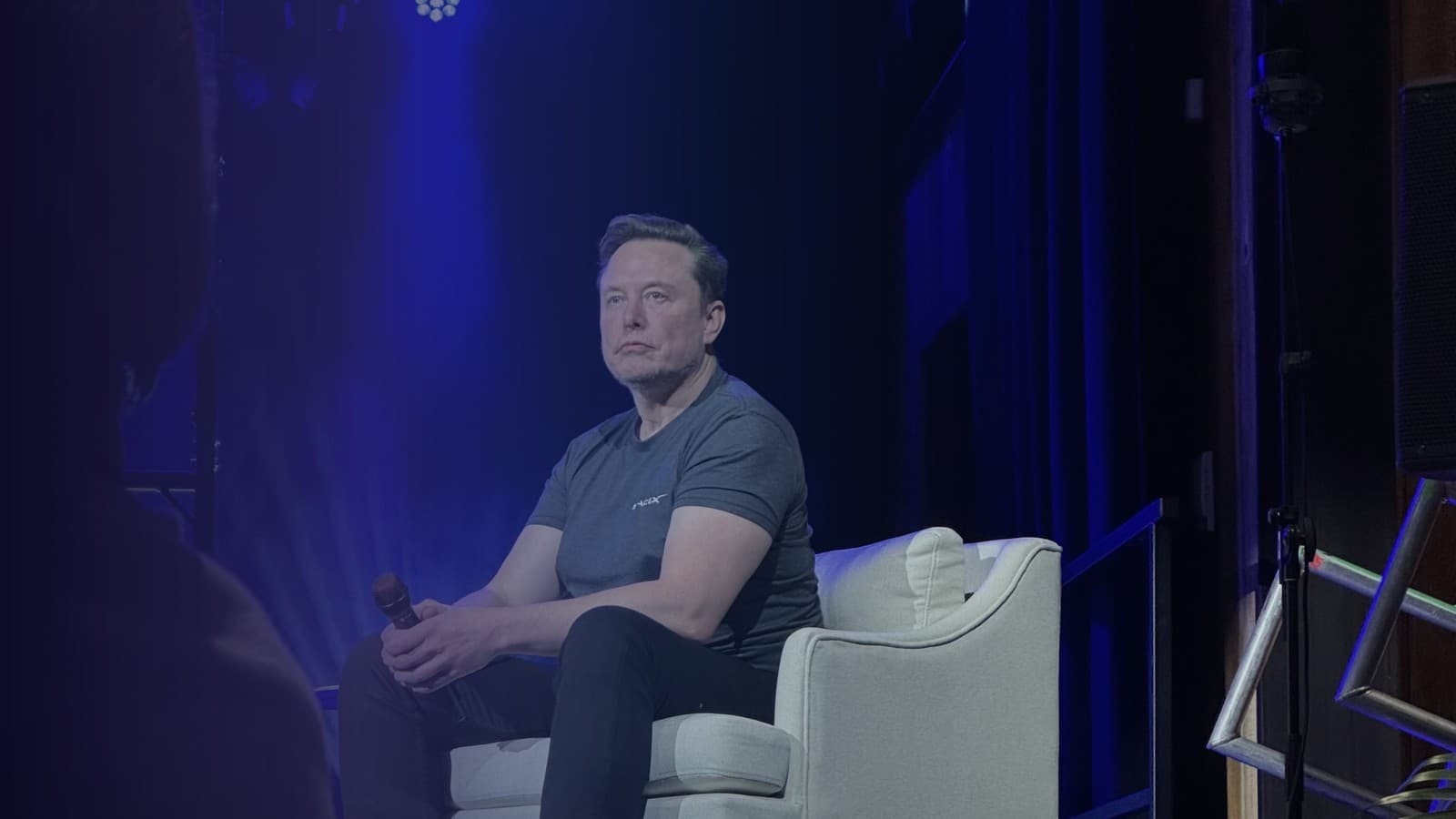
Somewhere inside Tesla's Texas gigafactory, the richest man in the world said two sentences that should have stopped the interview cold. The first: that artificial intelligence will exceed "the sum of human intelligence" in roughly five years. The second, delivered with a smile a few minutes later: "Money won't matter in 2036."
Most coverage of Elon Musk's full-length conversation with The Economist's Zanny Minton Beddoes will gravitate to the fireworks — the politics, the feuds, the wars. But the interview's real substance sits in three quieter claims that Musk has been polishing for a decade: that superintelligent AI is five years away, that work will become optional, and that humanity's answer is what he calls "universal high income." One of these claims is plausible. One is half-right in a dangerous way. And one collapses the moment you hold it against his own words from the same hour.
The useful exercise is not to cheer or scoff. It is to put each prediction in the dock, call the witnesses — including Musk's own record — and separate physics from fiction.
What he actually said
Strip away the banana-eating chimpanzee tangents and the ledger looks like this.
On humanity: AI will surpass the combined intelligence of all humans around 2031 ("roughly 5 years is my guess"), producing an "age of amazing abundance where anyone can have anything they can think of" — unless, he concedes, World War III intervenes. Humans are unlikely to remain "in charge"; if AI-to-human intelligence dwarfs the human-chimp gap, "it's hard to imagine that the chimpanzees would be in charge." His existential risk estimate remains "not zero," yet his stated philosophy is now to "look on the bright side," because the momentum of AI cannot be stopped — "even if I wanted to stop it and I couldn't."
On work: "Work is going to be optional." He offers the gardening analogy: nobody must grow tomatoes, but home-grown ones carry an artisanal charm. AI already beats "at least 90% of professional software engineers" at coding, heading toward 99% and then "Stockfish level" — the chess engine no human can touch — and that trajectory applies to everything digital first, physical next, once humanoid robots mature into what he calls the economy's "end effectors." He admits the transition will be "a bumpy road."
On income: the destination is not universal basic income but "universal high income," funded by — in its entirety — this sentence: "the Treasury should just simply issue people checks." When Beddoes, an economist, objects that printing money causes inflation, Musk unveils his own monetary theory: inflation is simply "the ratio of money to goods and services," so if AI-driven output rises 1,000%, governments can create money freely, and in fact "deflation will be the issue, not inflation." Taxation itself will become "somewhat irrelevant" as money does. For good measure: he has "set a record for the most amount of taxes ever paid by a human," expects to pay "many trillions" more, and took SpaceX public so ordinary people could own a piece of the upside.
That is the vision. Now the cross-examination.
Trial I: Superintelligence in five years
The case for the prosecution writes itself, because the star witness is Musk's own forecasting record. Full self-driving was "two years away" in nearly every year since 2016. Robotaxis were coming in 2020; Mars colonies have receded at a constant distance for a decade. When a man cries wolf on timelines, the rational prior is that the fifth wolf is also late. There is also a definitional dodge buried in the claim: "the sum of human intelligence" is not a measurable quantity, which makes the five-year deadline unfalsifiable — a prophet's trick, whether intended or not. Meanwhile the engineering bottlenecks are real: frontier training runs already strain grids, chip supply and capital, and the gap between benchmark scores and reliable real-world competence remains wide enough that AI agents still stumble over tasks a competent junior finishes before lunch. A widely cited 2025 study by the research firm METR measured how long a software task an AI agent can complete autonomously — a horizon doubling roughly every seven months, even as real-world reliability lags the benchmarks. Headline capability and workplace reality still run on different clocks.
The defense deserves its day too. Directionally, the skeptics have been losing for four years. Every careful forecast about AI capability made before 2022 has been beaten by events, not missed by them. Coding assistance did go from party trick to genuine junior-engineer substitution faster than almost anyone predicted. The employment canaries are already singing: Stanford Digital Economy Lab researchers found measurable employment declines for young workers in the most AI-exposed occupations, and even Amazon's cloud chief felt compelled to publicly dispute Dario Amodei's warning that half of entry-level white-collar jobs could vanish — disputes that only happen when a claim is credible enough to worry someone.
Verdict: plausible direction, hype deadline. Treat "five years" as marketing wrapped around a sincere belief — and notice that the sincerity is itself the problem, because the man building the thing believes it is unstoppable.
Trial II: Work becomes optional
Here Musk is half right, and the half matters enormously.
Half right: For cognitive, screen-based work, displacement is no longer speculation — it is data. The Stanford canary study shows it; Amodei has repeatedly doubled down on his warning; junior hiring in exposed professions has visibly slowed. The chess analogy Musk reaches for is genuinely apt: humans still play chess, and grandly, but nobody pays for human moves. A world where human cognition is artisanal — like his garden tomatoes — is no longer science fiction for a meaningful slice of white-collar labor. It is a mid-term forecast with receipts.
The other half: "Optional for everyone" quietly requires the robotics revolution to arrive on schedule, and there his record is weakest. Beddoes pressed exactly this point — humanoid capability "so far isn't there yet, is it?" — and got a restatement of the roadmap rather than an answer. Robots remain expensive, fragile and slow outside controlled factories; care work, trades and the vast informal economies of the developing world sit far beyond any end-effector. In Dhaka as in Ohio, most work is physical, improvised and relationship-based — precisely the terrain where robots remain furthest from competitive. Then there is the older lesson from Keynes, who predicted in 1930 that his grandchildren would work fifteen-hour weeks. Productivity did what he said; the fifteen-hour week never came, because work is not only income — it is status, structure and identity. Optional work for the wealthy is already here. Optional work as policy requires dignity to survive the transition, and on that subject Musk offers a shrug: "bumpy road."
Verdict: partially plausible, unevenly distributed. The safest formulation: by 2036, work will be optional for some, precarious for many, and compulsory for those who own nothing the machines need.
Trial III: Universal high income, printed into being
This is where the analysis gets stern, because the distribution scheme is the load-bearing wall of Musk's entire optimistic case — and it is built of assertion.
Start with the internal contradiction. Within one interview, money is destined for irrelevance by 2036 and Musk expects to personally pay "many trillions in tax," details his option-tax rates, and praises his IPO for letting the public own a piece of SpaceX. You do not optimize tax exposure on a currency you believe is becoming obsolete. Whatever the abundance end-state looks like, Musk himself behaves as though the intervening decades run on scarcity economics — because they do.
Next, the macroeconomics. His inflation formula — prices track the ratio of money to output — is a first-week-of-class simplification. It ignores velocity, import prices, asset bubbles, and above all sectoral reality: even a world of robot-made plenty still has location-constrained housing, energy bottlenecks and political price controls. Technology has produced genuine deflation in televisions and solar panels while healthcare and rent inflamed; averages hide the divergence people actually live in. And the historical evidence we do have on unconditional cash — Finland's national pilot, Stockton's guaranteed income, OpenResearch's three-year, $14 million Altman-funded study — converges on the same modest finding: transfers reliably ease misery while nudging work effort only at the margins — sometimes down, sometimes up depending on the pilot — but they restructure neither labor markets nor political order. Altman's own verdict on those results was that direct cash helps people but is not what the next phase needs. If the patron saint of AI capitalism funds the biggest test yet and it shows checks alone won't carry a transition, "simply issue people checks" is not a plan; it is a placeholder.
Finally, the deepest evasion. Beddoes asked the question twice, in economist's plain language: massive redistribution, higher taxes on capital, or people get nothing. Musk answered with his tax bill, his estate planning, and the Alaska Permanent Fund gestured at and dropped. But "universal high income" cannot exist without deciding who owns the machines — income flows to owners, and in Musk's future the owners are, on his own description, a handful of control-freak founders whose companies cannot vote them out. He knows this; as Beddoes presses him in the exchange, the post-IPO structure leaves him holding roughly 80% of voting shares — removable, if at all, only by a vote he himself controls. As for the public ownership he touts: by late July, SpaceX stock traded some 13% below its offer price. The abundance is real as engineering; as distribution it remains vaporware.
Verdict: coherent inside his premises, empty outside them. As physics, B+. As political economy, incomplete.
How to read a Musk prediction
Step back and the pattern resolves into three registers that deserve different trust levels. Engineering promises — reusable rockets, EV scale, satellite constellations — have mostly landed, late but landed; extend him conditional credibility there. Social forecasts — robotaxis by 2020, Mars cities, now five-year superintelligence — run chronically early and confidently wrong; discount them heavily. Economic end-states — money irrelevant, work optional, checks forever — are not forecasts at all but philosophy and positioning: they recruit talent, lift valuations, soften regulators and reframe his companies as inevitable rather than chosen. Notice, too, what the interview reveals beneath the optimism: a man who swings "from exhilaration to terror" intraday, who once priced extinction risk at 10–20%, and who now counsels "enjoy the ride." That is not analysis; it is coping with agency — and he is candid enough to say the quiet part: after creating OpenAI, watching Anthropic spin out of it and lead the field, he concluded that "all roads lead to acceleration... you can be sad about it or join the club." Fatalism from the single most powerful technologist alive is the actual news in this interview. The abundance talk is how he makes the fatalism bearable.
What wisdom does with all this
Neither panic nor paradise is a strategy. The wise reader drops the prophecy and watches the indicators: entry-level hiring in exposed professions (deteriorating), robotics unit economics (still brutal), energy buildout (real but lagging his timelines), and whether any government runs a transfer program larger than a pilot (none has). Watch especially who owns the machines during what Musk himself calls the bumpy road — because between his 2031 superintelligence and his 2036 post-money utopia lies a decade of displaced workers, concentrated returns and political rage that his framework waves through with a gardening metaphor. That gap between destination and path is where the actual politics of AI will be fought, country by country — and for emerging economies like Bangladesh, whose freelancers and factory floors sit squarely in the first wave of exposure, the difference between leapfrog and laggard will be decided by policy written in this decade, not by prophecies made in Texas.
Musk ended the exchange on consciousness propagating "into the future to the maximum degree possible." Fine. But consciousness also needs a livelihood in the meantime. The most honest sentence in the interview was not about abundance at all. It was the confession that nobody — least of all its chief architect — is steering. Believe the momentum; audit the fine print; fund the lifeboats. Everything else, enjoy the ride.
هل أعجبتك هذه الرؤية؟
شارك أفكارك أو تواصل معنا لمناقشة كيفية تطبيق هذه الاستراتيجيات على عملك.
تواصل معنا